
Security Guards for Commercial Parking Garages
A round that actually walks every level, not a camera feed nobody watches, because a garage's blind spots are the space between the cameras.
Request a proposalThe situation
What a multi-level garage deals with that a surface lot does not
A garage is levels, not a lot
A surface lot is one sightline; a five- or ten-level structure is a series of separate spaces stacked on top of each other, and a camera at the entrance tells an operator nothing about what is happening on level four while everyone's attention is on the ramp.
Break-ins happen between the cameras
Even a well-covered garage has gaps between fixed camera angles, especially in corners and behind support columns, and a break-in that takes under a minute rarely happens in full view of a lens; it happens in the space the last camera update did not reach.
Stairwells and elevators are the garage's dead zones
A stairwell that echoes and an elevator lobby with no natural foot traffic are where a person feels most isolated in a garage, whether that is a parker walking to a car after dark or someone with no legitimate reason to be there waiting for one.
Monthly parkers and daily visitors need different handling
A garage serving office tenants with monthly permits alongside daily and event parkers has two different populations to manage: a permit holder whose pattern the garage should know, and a transient parker who is, by definition, unfamiliar every time.
A garage is levels, not a lot
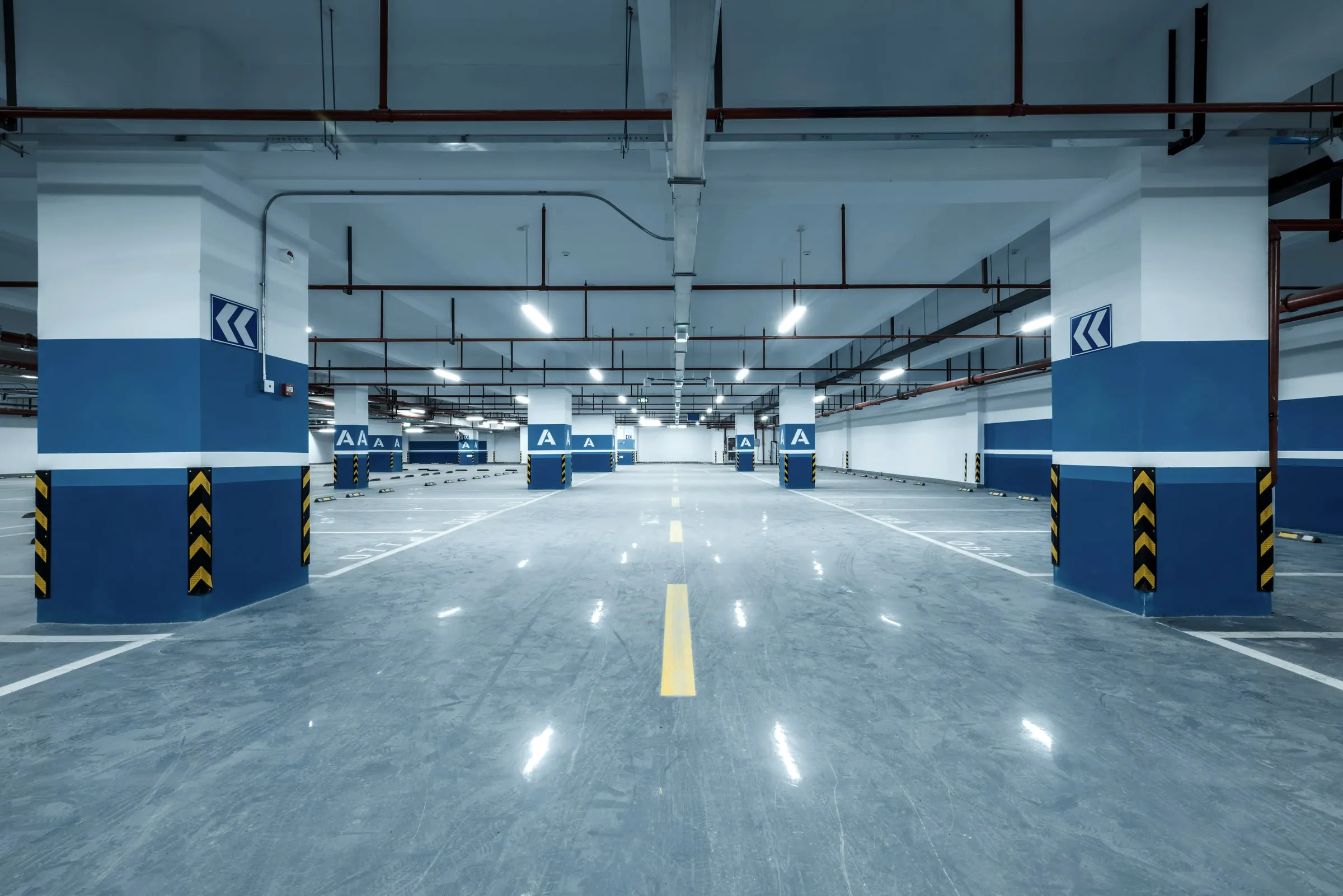
A surface parking lot is a single sightline an officer or a camera can take in from one position. A multi-level garage is a stack of separate spaces, each with its own corners, columns and blind approach, and treating it like a lot with a roof leaves most of it unwatched for most of the shift. Price Protection builds the round around the structure’s actual layout: every level walked on a rotating schedule rather than a single post at the entrance, so the coverage matches the way the space is actually built rather than the way it looks from the ramp.
Break-ins happen between the cameras
Even a garage with a full camera system has gaps between fixed angles, particularly around support columns and in the corners cameras are rarely positioned to cover well. A break-in that takes under a minute typically happens in exactly that space, not in clear view of a lens, which is why a camera system alone is not treated as a substitute for a physical round here. The officer uses the camera feed to direct attention toward whatever level shows activity, and the round itself covers the ground the cameras cannot.
Monthly permit holders and the transient gate
A garage serving office tenants with monthly permits alongside daily visitors and event parkers is managing two different populations with two different expectations. A permit holder expects a predictable, familiar routine and a garage that knows their pattern; a daily or event parker is unfamiliar by definition and needs clear direction rather than assumed knowledge of the property. The officer at a gated entry verifies both without holding up the line, and a failed access card or an expired permit is handled as a routine exception rather than a standoff at the arm.
Working with the garage operator
The daily report gives the garage operator a level-by-level account of the shift rather than a single note that the garage was checked, including lighting outages, camera gaps and any vehicle or person of concern encountered on a specific level. Over time that record tells the operator which levels see the most activity worth watching and where lighting or camera investment would do the most good, turning the daily report into a planning tool rather than only an incident log.
Starting coverage
To begin, dispatch needs the garage’s address, the number of levels and any gated entries or exits, the hours coverage is wanted, and the operator’s contact for lighting, camera or gate issues found on a round. An unarmed officer can typically start walking rounds within hours of a signed proposal, with the schedule adjusted over the first weeks to match the garage’s actual peak hours.
How we cover it
Every service, applied to this post.
- Unarmed security guards
An unarmed officer walks a scheduled round through every level of the garage rather than remaining at the entrance, checking stairwells, elevator lobbies and parked rows for anything that a static camera view alone would miss.
- Camera monitoring
Where the garage has its own camera system, the officer monitors it from a booth or a mobile position and uses it to direct the physical round toward whatever level or corner the cameras show activity in, rather than replacing the round with the feed.
- Access control
At a gated garage, the officer verifies monthly permits and daily tickets at the point of entry or exit when the automated gate needs a person, and handles a parker whose access card fails without holding up the line behind them.
- Vehicle patrol
For attached or adjacent surface lots that share the garage's access, a patrol vehicle covers that ground on the same round, since a garage operator's exposure often extends past the structure itself.
- Incident reporting
The daily report lists rounds completed by level, any vehicle or person of concern encountered, lighting or camera outages found, and incidents at the entrance or exit gates, sent to the garage operator each morning.
A typical post
What a shift looks like here.
The daytime officer works a scheduled round through every level on a rotating basis rather than a fixed post, timing the walk to match peak arrival and departure windows when the garage sees the most vehicle and pedestrian movement and the most opportunity for a mismatch between the two to go unnoticed.
Stairwells and elevator lobbies get specific attention on each round rather than a glance in passing, since these are the spaces parkers describe as feeling least safe and where an incident is most likely to happen without another person nearby to see it.
As the garage empties in the evening, the round shifts toward the levels with the fewest remaining vehicles, since a nearly empty level is both the easiest place for a break-in to go unnoticed and the loneliest walk for the last few parkers leaving for the night.
Where the garage runs an overnight shift, the officer checks that gates and pedestrian doors that should be locked are locked, that lighting outages reported the day before have been addressed, and closes the shift with a report noting anything the operator needs before the morning rush begins.

Reporting
What the daily report covers here
Every client receives a written report each day, and officer performance is reviewed and documented daily. This is what the report records on this kind of post.
- Rounds completed, by level and by time
- Stairwell and elevator lobby checks, with anything found
- Lighting or camera outages found and reported to the operator
- Vehicles or persons of concern encountered, with the level and outcome
- Gate or entry issues, including failed permits or access cards
- Vehicle break-ins or damage reported, with the level and any camera reference
Do you patrol every level or just the ground floor and entrance?
Every level, on a rotating schedule through the shift. A garage's exposure is spread across its levels, and a post that never leaves the entrance leaves the upper floors unwatched for the entire shift.
Can an officer help with a failed permit or access card at the gate?
Yes, where the garage wants that coverage. The officer can verify a monthly permit or daily ticket manually when the automated gate fails, so a parker is not stuck at the arm while a technical issue is resolved.
Do you work with the garage's existing camera system?
Yes. The officer monitors the existing cameras where the garage has them and uses that feed to direct the physical round rather than treating the cameras as a replacement for someone actually walking the levels.
How do you handle a report of a break-in after the fact?
The officer documents the vehicle, the level and the approximate time based on the round schedule and any available camera footage, and the report goes to the operator with enough detail to support a claim or a police report.
Can coverage focus on evening and overnight hours only?
Yes. Many garages need the heaviest coverage after the daytime attendant or gate staff leaves, and the proposal can be scoped to evening and overnight rounds rather than a full daytime post.
Related pages
Industries we serve
Service areas
Insights
Glossary
Request a proposal
Request a proposal for commercial parking garages.
Two short steps. Dispatch reviews every request and calls you back about coverage. For urgent unarmed coverage we can typically staff most sites within hours.
24-hour dispatch
(281) 326-9189