
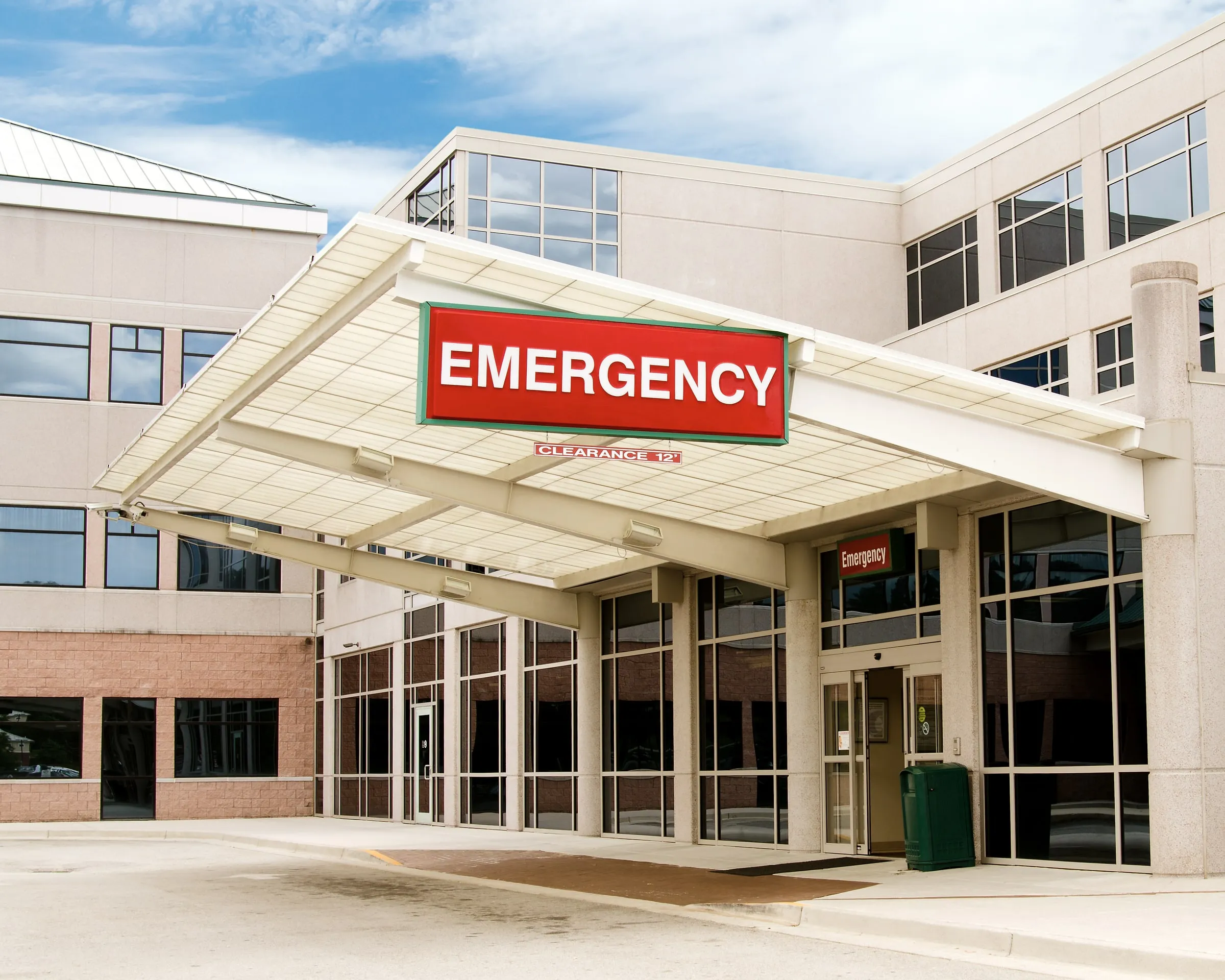
Security Guards for Emergency Departments
A steady officer in the waiting room and at the ambulance bay, present for the hour that is never predictable in advance.
Request a proposalThe situation
What an emergency department deals with in its waiting room
No slow hour
An emergency department takes arrivals at three in the afternoon and three in the morning with the same seriousness, and the waiting room can go from three chairs filled to standing room in the time it takes one ambulance and two walk-ins to arrive together.
A waiting room under strain
Families wait for news they do not have yet, in a room with strangers who are waiting for the same thing. Tempers run short over how long a wait has been, and a raised voice in a waiting room spreads faster than in almost any other room in the building.
Arrivals in police custody
A patient arrives with a law enforcement escort, and the department has its own rules for where that patient is placed, who stays with them, and how the officer's presence and the department's own posted officer work in the same hallway without confusion.
The ambulance bay is a traffic problem too
Ambulances, private vehicles dropping off a patient who cannot wait, and staff arriving for a shift change all use the same bay, and a bay that is not kept clear slows the next ambulance in, not just the next parking spot.
The waiting room is the post
An emergency department’s waiting room is where nearly everything a security post has to handle actually happens: long waits, families who do not yet know how serious an injury is, a disagreement over who was seen first. Price Protection’s post orders put the officer in the room itself rather than at a fixed desk, because a raised voice noticed early and approached calmly rarely becomes anything more, and the same voice ignored for ten minutes usually does. The officer is trained in de-escalation, and the department’s own rule for when to call the charge nurse or police is written into the post orders rather than left to judgment in the moment.
Arrivals that do not follow a schedule
Unlike a lobby with predictable traffic, an emergency department gets its busiest minutes without warning: an ambulance, two walk-ins and a police escort can arrive together at three in the morning as easily as at three in the afternoon. The post is built around that unpredictability rather than a fixed schedule. The officer checks the ambulance bay between rounds of the waiting room, keeps it clear of parked vehicles that are not actively loading or unloading a patient, and is close enough to the bay doors to respond the moment traffic backs up.
The door that has to hold
Every emergency department has one door that separates the waiting room from the treatment area, and it is the door where most of a department’s access-control problems concentrate: a family member trying to follow a patient back before being cleared, a visitor who does not want to wait for an update. The officer works with the triage desk on who is buzzed through, holds the line at that door courteously, and refers every dispute about it to the department’s own staff rather than deciding who is allowed back.
Arrivals in police custody
When a patient arrives with a law enforcement escort, the department has its own protocol for where that patient is placed and who stays nearby, and the posted officer’s role is kept separate from it: watching the waiting room and the entrance, not the patient or the escorting officer’s custody. Post orders written with the charge nurse spell out exactly where the posted officer stands during one of these arrivals so two uniformed presences in the same hallway do not create confusion about who is doing what.
Starting coverage
To begin, dispatch needs the department’s address, the hours coverage is wanted, whether the post covers the waiting room alone or the ambulance bay as well, the charge nurse’s contact and whether an armed presence has been requested. A supervisor walks the department with the charge nurse, post orders are written together, and an unarmed officer can generally be in the waiting room within hours once the department is ready to start.
How we cover it
Every service, applied to this post.
- Unarmed security guards
An unarmed officer works the waiting room and the ambulance bay entrance, present where families are waiting rather than at a desk out of sight, and steps in early when a wait or a disagreement starts to escalate.
- Armed security guards
Where the department has asked for an armed presence at the triage or ambulance bay entrance, a commissioned officer is positioned there under post orders that keep observe-and-report the default and hand enforcement to police.
- Access control
The door between the waiting room and the treatment area is the one door in the department that matters most; the officer works with the triage desk on who is buzzed through and keeps family members from following a patient back without being cleared.
- Camera monitoring
Where the department gives access, the officer watches the waiting room and ambulance bay cameras from a post at the entrance, useful for confirming a wait time dispute or an incident the staff did not see directly.
- Incident reporting
A report after every shift lists waiting room contacts, ambulance bay activity, any law enforcement custody arrival and anything the charge nurse should read before the next shift starts.
A typical post
What a shift looks like here.
The evening officer takes the waiting room from the day shift with a note on how full it is and whether anyone has been waiting long enough to be a concern. Ambulances arrive on their own schedule, not the officer's, so the ambulance bay gets a check between rounds of the waiting room rather than a fixed round time.
As the evening goes on, the waiting room fills with the after-work and after-school arrivals departments see every night: minor injuries, a parent with a feverish child, a walk-in who has been putting off a visit. The officer reads the room rather than the clock, moving toward a raised voice or a family that has been standing at the desk too long before either becomes the reason someone else in the room gets upset.
Overnight the crowd thins but does not disappear, and the arrivals get harder: an ambulance with a law enforcement escort, a patient brought in by police, a family arriving from an accident scene without warning. The officer works with the triage desk on where each arrival goes and stays near the door between the waiting room and the treatment area, the one door that has to hold.

Reporting
What the daily report covers here
Every client receives a written report each day, and officer performance is reviewed and documented daily. This is what the report records on this kind of post.
- Waiting room headcount and wait-time contacts, with the outcome
- Ambulance bay arrivals and any vehicle blocking the bay
- Law enforcement custody arrivals, with the time and the officer's agency
- Contacts with a person in distress or becoming disruptive, and the outcome
- The treatment-area door: who was buzzed through and who was held at the waiting room
- Anything the charge nurse or department manager asked the post to watch for
Is the officer positioned in the waiting room or at a desk?
In the waiting room, visible where families are sitting rather than at a desk near the entrance. Most escalation in an emergency department starts in the waiting room, and a visible officer there is the most useful post there is.
How do you handle a patient who arrives in police custody?
By the department's own rules for that situation, worked out with the charge nurse and the escorting agency. The post officer's role is the waiting room and the entrance, not the patient's care, and the two stay clearly separated.
Can the officer keep a family member from following a patient into treatment?
Yes, working with the triage desk on who is cleared to go back. The officer holds the door, not the decision; the department's own staff decide who is allowed through and when.
What happens when the waiting room gets overcrowded and tense?
The officer moves through the room rather than staying at a fixed point, speaks with the people who have been waiting longest, and calls for the charge nurse or, if needed, police, before a disagreement becomes something larger.
Do you staff the ambulance bay separately from the waiting room?
Usually the same officer covers both, checking the bay between rounds of the waiting room. A department with heavy ambulance traffic can request a second post for the bay alone.
Related pages
Industries we serve
Service areas
Insights
Answers
Glossary
Request a proposal
Request a proposal for emergency departments.
Two short steps. Dispatch reviews every request and calls you back about coverage. For urgent unarmed coverage we can typically staff most sites within hours.
24-hour dispatch
(281) 326-9189