
Property manager guides
Hospital and Clinic Security: Balancing Safety and Patient Experience
By Price Protection SecurityReviewed TX DPS Lic #B09430601
Short answer
Hospital and clinic security has to do two things that can pull against each other: keep staff, patients and visitors safe, and keep a space that already feels stressful from feeling like a checkpoint. The balance comes from matching posture to the setting: a calm, visible presence and de-escalation skill in a waiting room, a firmer controlled-entry post at an emergency department, and a lighter, appointment-paced presence at a small clinic. The training stays the same; how it is applied changes by room.
The tension every healthcare post has to resolve
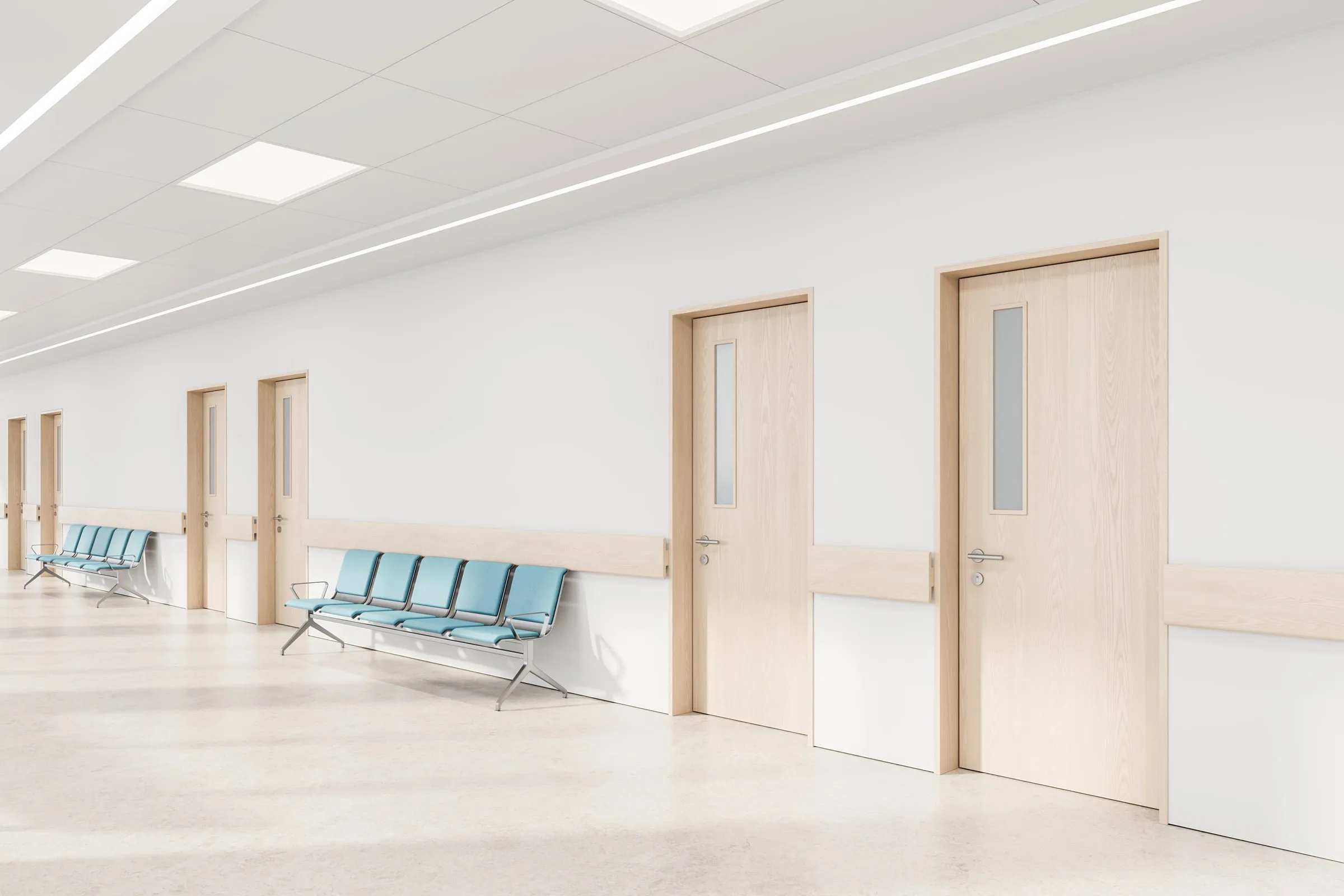
A hospital or clinic needs security for the same reasons any large building with public access does: entrances that need controlling, a lot that needs watching at shift change, and situations that occasionally require more than a receptionist can handle. It also serves people who are, by definition, having one of the worse days of their year, arriving frightened, in pain, or worried about someone who is. A security posture built for a retail store or an office lobby, heavy on visible authority, can make that experience worse rather than better. The balance a healthcare post has to strike is presence without intimidation: an officer who is unmistakably there, and who spends most of the shift making the space feel calmer rather than more tense.
Emergency departments: where de-escalation is the primary skill
The emergency department entrance and waiting room see the facility’s highest concentration of stress, and the officer posted there is doing a fundamentally different job from an officer at a quiet office lobby. Families wait for news they are afraid to hear. Patients arrive in pain, sometimes under the influence, sometimes combative not from anger but from fear or a medical condition itself. The officer’s training in de-escalation, keeping distance, speaking calmly, giving people room, matters more here than almost anywhere else Price Protection staffs, because the goal in nearly every encounter is to lower the tension in the room, not to demonstrate authority in it. Physical intervention is the last resort, used only in defense, with the officer working alongside nursing staff and the facility’s own security department rather than acting alone.
Clinics and medical office buildings: a different scale entirely
A freestanding clinic, an urgent care center or a medical office building rarely has a security department of its own, which means the post it books is the whole answer rather than a supplement to one. The pace is set by appointments rather than a continuous flow: an officer at the entrance during clinic hours, greeting and watching who comes and goes, coverage of the parking lot as staff and patients leave after dark, and a calm presence available if a patient dispute or a distressed visitor needs one. The posture here leans lighter than an emergency department’s, because the setting itself is quieter, but the same de-escalation training applies the moment it is needed.
Behavioral health units and family conflict
Behavioral health settings call for a particular kind of restraint. A patient in crisis needs a room that stays calm, not one where a uniformed presence reads as confrontation. The officer’s role in these areas leans toward observation and support for clinical staff rather than a visible, active post, positioned to respond quickly without being the first thing a distressed patient sees. Family conflict, a common reason security is called anywhere in a hospital, follows a similar logic: two family members arguing in a hallway over a patient’s condition need space and a quiet word more often than they need an order to stop.
| Setting | Posture that fits | What the officer is mainly doing |
|---|---|---|
| Emergency department | Controlled entry, visible but calm | De-escalation, managing the waiting room |
| Main lobby | Visible and welcoming | Directing visitors, watching who enters |
| Clinic or medical office | Lighter, paced to appointments | Entrance presence, lot coverage at closing |
| Behavioral health unit | Present but restrained | Support for clinical staff, quiet observation |
| Parking structure | Visible during shift change | Escorts, watching for vehicle break-ins |
Parking, shift change and the hours after dark
A hospital’s parking structure sees its own version of the balance. Staff walking to their cars after a night shift want to feel safer, not more anxious, and an officer positioned to be seen without being intrusive, offering an escort rather than announcing a patrol, does more for that feeling than a heavier presence would. Shift change, when the largest number of staff move through the garage at once, is the period most posts are built around, because it is both the highest-traffic moment and the one where an escort is easiest to offer without anyone having to ask for one directly.
Working alongside the facility’s own department
Most hospitals of any size run a security department with its own command center, cameras and procedures, and private officers work inside that structure rather than replacing it. Contracted coverage typically fills posts the department cannot staff continuously, covers off-campus clinics and medical office buildings outside the main campus, and provides fire watch when a sprinkler or alarm system is out of service in a building that cannot simply be evacuated of patients. Because an occupied healthcare building cannot be treated like a vacant office when a life-safety system goes down, this fire watch coverage is planned with the facility’s own impairment procedures and the authority having jurisdiction, not staffed as an afterthought.
What the balance actually looks like day to day
In practice, balancing safety and patient experience is less about any single dramatic decision and more about dozens of small ones across a shift: choosing to greet rather than scan, choosing to explain a wait rather than enforce a line, choosing a quiet word over a raised one. The training a healthcare officer carries, first aid, incident reporting, de-escalation and, where the post is armed, state-certified firearms proficiency, is the same across every setting. What changes is how visibly that training shows, matched to a room that is meant to feel like care first and security second.
Questions
Related questions
Should security be visible at every entrance of a hospital?
Not necessarily the same way at every entrance. A main lobby usually calls for a welcoming, visible presence; an emergency department entrance often calls for a controlled-access post because it sees the facility's highest tension; a staff or supply entrance may need only access control without a public-facing post at all. The building's own layout, not a single formula, decides where each posture fits.
How is a security post different at a small clinic than at a hospital?
Scale and pace. A hospital runs continuously with a security department of its own that private officers supplement; a clinic or medical office building often has no security department at all and books a full post for its own hours: an officer at the entrance during appointment hours, coverage of the lot at closing, and someone available for a patient or visitor who becomes distressed.
What does de-escalation actually look like in a healthcare setting?
Distance, a calm voice, and time before force is ever considered. Families in an emergency department are often frightened rather than dangerous, and an officer's first response is to lower the tension, not raise it: acknowledging the wait, getting a nurse involved early, and treating most situations as something to talk through rather than confront.
Do hospital security officers carry weapons?
Some posts are armed and some are unarmed, and the facility decides which fits each location, often armed at a main entrance or emergency department and unarmed at a clinic or office building. Officers are trained in security protocols, de-escalation, first aid and incident reporting regardless of whether the post is armed, because most of a healthcare shift is presence and conversation, not force.
Related pages
Industries we serve
Insights
Answers
Glossary
Request a proposal
Request a proposal for your property.
Two short steps. Dispatch reviews every request and calls you back about coverage. For urgent unarmed coverage we can typically staff most sites within hours.
24-hour dispatch
(281) 326-9189