
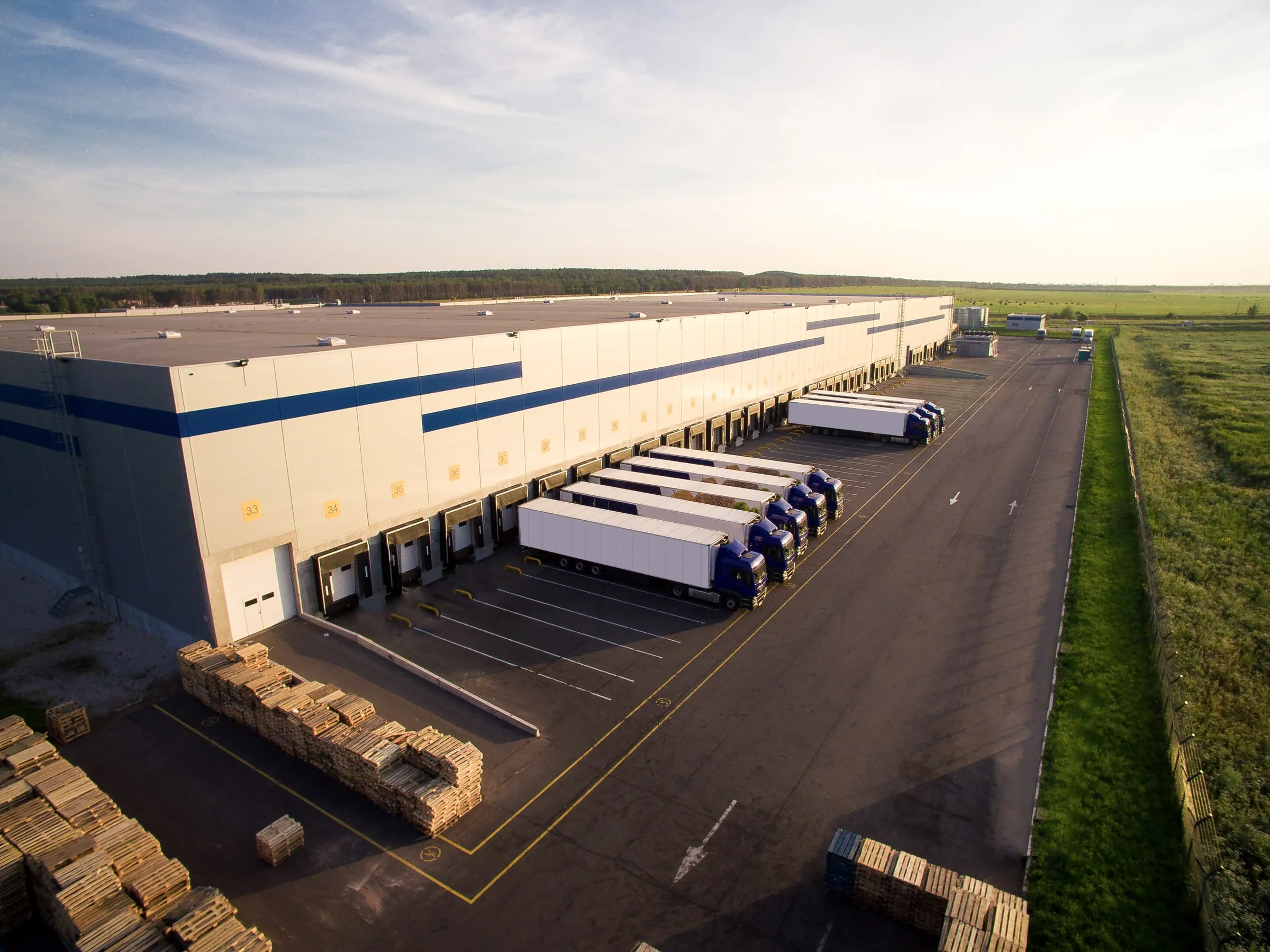
Security Guards for Distribution Centers
One post that manages the trailer pool, checks a large rotating workforce at the badge reader and hands operations a clean report at every shift change.
Request a proposalThe situation
What a distribution center deals with that a smaller warehouse does not
A trailer pool bigger than the building
A cross-dock or fulfillment site can have more trailers staged in the yard than doors on the building, shuttled by yard trucks between drop spots, and a pool that is not tracked position by position is where a trailer goes missing for a shift before anyone notices.
Shift change moves hundreds of people through one door
A distribution center's workforce turns over in waves, and the employee entrance sees a crowd at shift change that a single badge reader cannot watch on its own; a lost or shared badge is easiest to catch at that door, not after the fact.
Seasonal peak triples the traffic without warning
Volume through October and December can run far above the rest of the year, with extra trailers, temporary staff and extended hours added on short notice, and the gate has to absorb it without slowing the appointment schedule down.
Returns and reverse logistics create a second flow
Product coming back into the building moves opposite the outbound flow, often through a separate door with its own paperwork, and a site that only watches outbound traffic misses the door where returns and damaged freight pile up unlogged.
Two flows, one badge reader
A distribution center is a warehouse scaled up until its traffic becomes the main problem. Hundreds of employees cross one entrance at shift change, a trailer pool bigger than the building’s own door count sits in the yard, and product moves both outbound and back in through returns. Price Protection sets the post up to watch whichever of those flows the site’s layout makes the bottleneck, most often the employee gate at shift change and the yard between appointments.
Reading the yard like a lot, not a line
At a cross-dock or fulfillment site the trailer count in the yard often exceeds the number of doors on the building, with yard trucks shuttling drop trailers between staging spots all day. A patrol that only drives past misses a trailer moved off its logged position; the post orders here call for the officer to confirm the pool against the yard management log on a set schedule, on foot where the lot is dense, so a discrepancy is caught the same shift it happens rather than at the next inventory count.
Shift change is the busiest hour of the day
The employee entrance at a large distribution center sees more people in twenty minutes at shift change than most warehouses see all day, and that crowd is exactly when a shared or lost badge is easiest to miss. The officer works the line at the reader rather than standing at a distance, and during peak season, when temporary staff are added on short notice, faces are checked against the staffing agency’s roster rather than assumed because the badge scanned.
Peak season is planned, not improvised
Volume through the fall shipping season can run well above the rest of the year, and the post orders for that stretch are written before it starts: extra hours at the employee gate, a second officer if the site adds one, and a plan for the overflow lot if trailers spill past the regular yard. The arrangement is set with the operations manager ahead of the surge so the gate does not fall behind the schedule on the first heavy day.
Starting coverage
To begin, dispatch needs the badge or access system in use, the yard layout and trailer pool size, the appointment process for carriers, the returns door procedure and the staffing agency contact for peak season. Coverage typically starts with an unarmed post at the busiest gate, and a second post or a vehicle patrol is added once the operations manager sees how the traffic actually runs.
How we cover it
Every service, applied to this post.
- Unarmed security guards
An unarmed officer staffs the guard booth at the property entrance or the employee gate, checking every vehicle and pedestrian against the access list and watching the flow of trailers into the yard during peak hours.
- Access control
Employee, contractor and visitor access is checked against the building's own badge system or a paper list where badges are not yet issued, with temporary staff verified against the staffing agency's roster during peak season.
- Vehicle patrol
A marked vehicle tracks the trailer pool position by position on a written route, confirms yard truck moves against the yard management log, and checks the perimeter fence and the overflow lot used during peak.
- Camera monitoring
The distribution center's camera system is watched from the guard post, covering the employee entrance, the trailer yard and the returns door, with footage pulled for the operations team when a trailer count does not match the log.
- Incident reporting
A daily report goes to the operations manager: entries and exits by gate, trailer pool counts against the yard log, badge issues at the employee entrance, and anything unusual at the returns door.
A typical post
What a shift looks like here.
The officer opens the employee gate ahead of the first wave of shift workers, watching the badge reader line rather than standing back from it, since a shared badge or a tailgating entry is caught in the moment or not at all. The morning trailer count is taken and checked against the yard log before the first appointment of the day arrives.
Through the day the officer's attention splits between the property gate, where carriers check in against the appointment schedule, and the yard, where a marked vehicle or a walking round confirms trailer positions as the yard crew shuttles them. During peak season the same post covers a longer line of temporary staff at the badge reader, verified against the staffing roster rather than waved through.
At shift change the outgoing officer walks the departing crowd's flow at the employee exit while the incoming officer takes the gate log and the current trailer count. The returns door is checked last, since it runs on its own schedule, and anything found there goes into the report before the operations manager's morning meeting.

Reporting
What the daily report covers here
Every client receives a written report each day, and officer performance is reviewed and documented daily. This is what the report records on this kind of post.
- Entries and exits by gate: employee, visitor, carrier
- Trailer pool count against the yard management log, by position
- Badge issues at the employee entrance: shared, missing, expired
- Temporary staff verified against the staffing agency roster
- Returns door activity and any unlogged freight found there
- Perimeter and overflow lot checks during peak season
Can you scale coverage up for peak season?
Yes. Distribution centers add hours, a second post at the employee gate, or overflow lot patrol for the peak months, and the arrangement is agreed with the operations manager ahead of the volume increase so the extra coverage is in place before the first surge.
Do you track the trailer pool or just the gate?
Both, where the site wants it. A vehicle patrol on a written route can confirm trailer positions against the yard management log, which matters most at a cross-dock where the pool outnumbers the building's own doors.
How are temporary and agency staff checked in?
Against the roster the staffing agency or the distribution center provides for that shift. An officer without a current roster holds new faces at the gate and calls the site contact rather than guessing who is expected.
Is the returns door covered the same as outbound?
It is covered on its own terms, since it runs a different schedule and paperwork. The post orders say how often it is checked and what gets logged, so damaged or unlogged freight at that door does not sit unnoticed.
What does the operations manager actually see in the report?
Gate activity by time, the trailer count against the yard log, any badge or roster mismatch, and anything found on patrol, formatted so it can be read in the morning meeting rather than pieced together from notes.
Related pages
Industries we serve
Service areas
Insights
Glossary
Request a proposal
Request a proposal for distribution centers.
Two short steps. Dispatch reviews every request and calls you back about coverage. For urgent unarmed coverage we can typically staff most sites within hours.
24-hour dispatch
(281) 326-9189