
Fire watch and compliance
Why a Fire Watch Continues 30 Minutes After Hot Work Ends
By Price Protection SecurityReviewed TX DPS Lic #B09430601
Short answer
A fire watch continues after hot work stops because the fire it guards against often does not start until later. A hot ember or a bead of slag can lodge in insulation or a wall cavity and smolder without flame before it catches. OSHA 29 CFR 1910.252(a)(2)(iii) sets a 30-minute minimum after the work ends; NFPA 51B asks for at least an hour, with further monitoring at the permit authorizing individual's discretion. The permit and the site's authority having jurisdiction decide which window applies.
The fire that starts after everyone has gone
Torch work throws two kinds of hazard: the visible spray of sparks while the tool is running, and a second, quieter one that shows up afterward. A piece of hot slag that rolls into a gap between decking, a spark that lands in the paper facing of insulation, or heat conducted through thin metal into a void behind a wall does not always burst into flame right away. It smolders, sometimes for close to an hour, charring material slowly until enough oxygen and fuel line up for it to catch. By the time smoke is visible from a hallway or a unit below, the ignition point can be well hidden and already established. This is the pattern behind a large share of hot-work fires, and it is the entire reason the fire watch does not end when the welder shuts off the gas.
What the standards require, and why they differ
OSHA’s welding standard, 29 CFR 1910.252(a)(2)(iii), requires the fire watch to be maintained for at least 30 minutes after welding or cutting operations are completed, specifically to detect and extinguish possible smoldering fires that a visual check at the moment work ends would miss. NFPA 51B, the standard most hot-work permit programs build their own rules around, asks for a longer minimum, at least one hour, and gives the permit authorizing individual room to require further monitoring beyond that where the material or the location warrants it, such as a roof deck over an occupied floor or a wall assembly with unknown cavities.
The two numbers are not in conflict; they are a floor and a stricter floor. Where a site’s own hot-work permit follows NFPA 51B, that hour controls the job regardless of what OSHA’s minimum allows, and Price Protection staffs whichever period the permit sets rather than defaulting to the shorter number.
| OSHA minimum | NFPA 51B minimum | Who can extend it | |
|---|---|---|---|
| Post-work watch | 30 minutes | 1 hour | The permit authorizing individual, based on conditions |
| Applies to | Welding, cutting, brazing under general industry rules | Sites using an NFPA 51B-based permit program | The site’s own authority having jurisdiction |
| What it protects against | Smoldering material not yet visibly burning | Same, with a wider margin for concealed spaces | N/A |
What the watch looks like during that window
The officer does not leave with the crew and does not simply glance around once. The job is to stay with the work area and the spaces heat could have reached: the underside of a deck that was just cut, the far side of a wall that was welded, a parapet and its drains after torch-down roofing, the void above a ceiling near an opening. Extinguishers stay within reach the whole time. The officer looks and smells for smoke on a short, repeated cycle rather than a single pass, because a smolder can start ten minutes into the period as easily as in the first thirty seconds, and logs the start time, the checks made and the closing time when the period has run clean.
Roofing is where this matters most
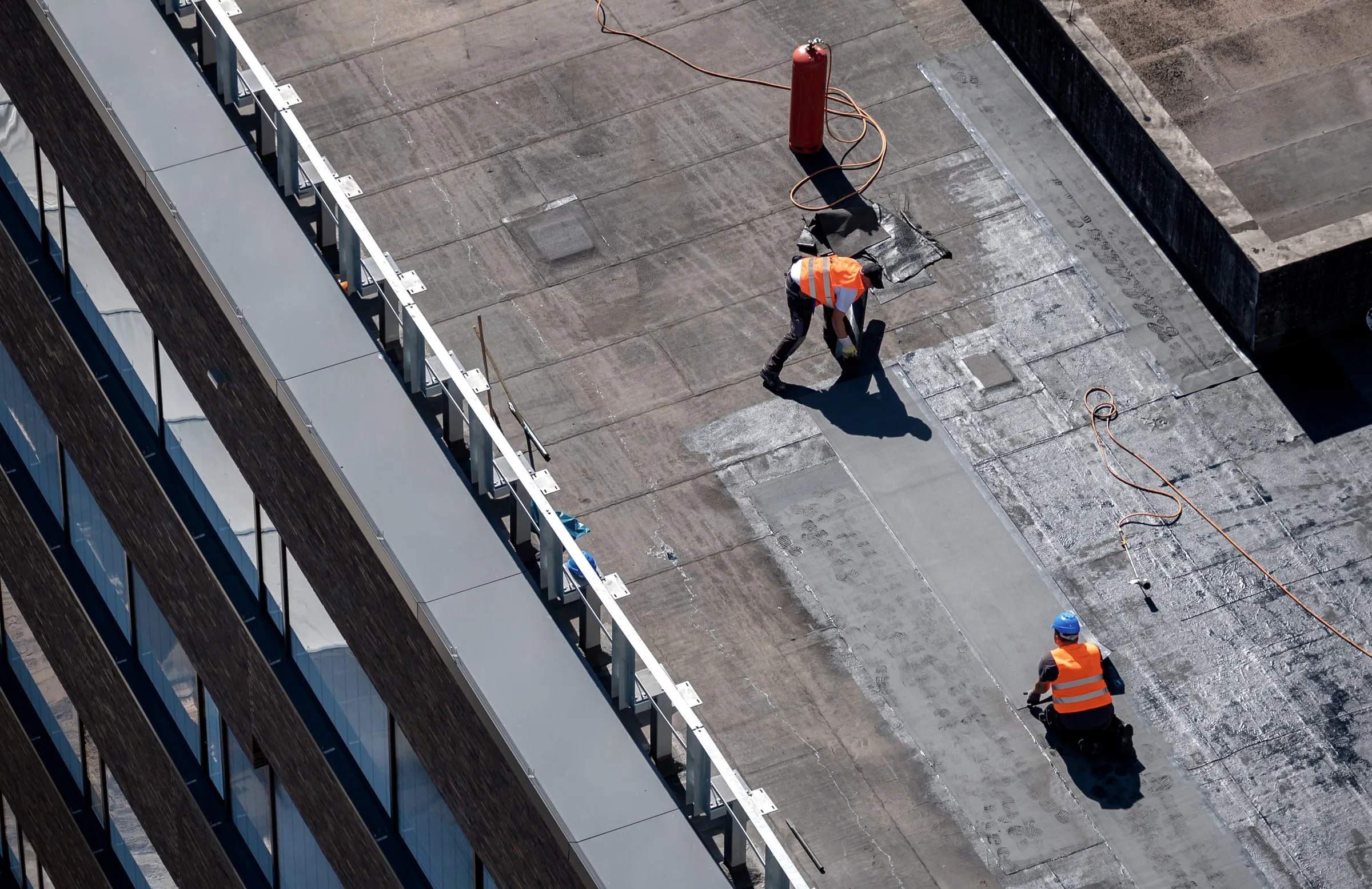
A torch-applied or hot-air-welded membrane sits directly over insulation and a deck, often with older roofing material underneath that nobody has inspected in years. A spark or a bead of hot bitumen that finds a seam can travel through the insulation before it shows itself, and a roof is one of the few places in a building where nobody is walking through and noticing smoke by accident. That combination, hidden fuel and low foot traffic, is why roofing contractors’ own permits usually require the fire watch as a firm condition of the work, separate from whatever the property’s insurer requires. The roofing fire watch article covers what a watch on a roof specifically checks, floor by floor, below the work.
When more than one crew is working
A single job site with two or three welders cutting on different floors or different ends of a building rarely finishes at the same minute, and the post-work period runs separately for each. If one crew finishes at ten and a second finishes at eleven, the fire watch covering the first area cannot stand down at half past ten just because the second crew is still working nearby; the two clocks run independently, tied to when each specific operation actually stopped. On a large renovation or a multi-trade construction floor, this often means staggered fire watch coverage rather than one officer moving between areas, since a period that has not finished cannot be left unattended to cover a different one that just started.
Closing the watch properly
The post-work period ends only when the full window has passed with nothing found, not when the crew is ready to leave or the contractor wants to close out the permit early. The officer’s final entry records the end time, confirms the area is clear, and is signed for the permit file, which is often what a fire marshal or an insurer wants to see if a question comes up later.
If something is found before the period ends
A faint smell of smoke or a warm spot discovered fifteen minutes into the post-work period is treated as a possible fire, not a curiosity to note and keep walking past. The officer checks it directly, and if it is confirmed as smoldering material, the extinguisher that has been within reach the whole time gets used on it while it is still small, the finding goes into the log with the exact time, and the post-work clock effectively restarts from that point, since the area has just shown it needs continued attention rather than less. Contractors are notified immediately if the finding affects work they believed was finished, since a spot that smolders once can smolder again nearby.
This is a summary, not legal advice. The permit and the authority having jurisdiction for a specific site set the exact period that applies.
Questions
Related questions
Can the post-work period be shortened if the crew checks the area first?
No. A quick look after the tools are down does not substitute for the watch period the standard sets. Smoldering material is, by definition, not visibly burning yet, which is exactly why a timed watch rather than a single check is required.
Does the clock reset if the crew resumes cutting after a break?
Yes, in effect. If welding or cutting starts again, the watch is still active from the original start, and the post-work period is measured from whenever the hot work actually finishes for the day, not from an earlier pause.
What is the officer actually looking for during that period?
Delayed ignition, not an active fire: a faint smell of burning, a thin curl of smoke from a wall cavity or under a membrane, discoloration spreading on a ceiling tile, or heat radiating from a spot that was cool minutes earlier. None of that shows up in a five-second glance, which is the reason the period is timed rather than left to judgment.
Related pages
Services
Insights
- OSHA Fire Watch Rules for Hot Work: 29 CFR 1910.252 Explained
- The 35-Foot Rule: When Welding and Cutting Need a Fire Watch
- Fire Watch During Roofing and Torch-Down Work
- Fire Alarm Outages: When a Fire Watch Is Required
- Fire Extinguisher Checks During a Fire Watch
- Fire Watch After a Fire: Securing a Damaged Building
Answers
Glossary
Request a proposal
Request a proposal for your property.
Two short steps. Dispatch reviews every request and calls you back about coverage. For urgent unarmed coverage we can typically staff most sites within hours.
24-hour dispatch
(281) 326-9189