
Fire watch and compliance
Fire Extinguisher Checks During a Fire Watch
By Price Protection SecurityReviewed TX DPS Lic #B09430601
Short answer
On every round, a fire watch officer confirms each extinguisher on the route is in place, that its pressure gauge reads in the operable range, that the pin and tamper seal are intact, that its inspection tag is current, and that nothing blocks the path to it. The officer does not service or recharge extinguishers; a failed check is logged and reported to the coordinator or the permit's authorizing individual so the building or the contractor can address it.
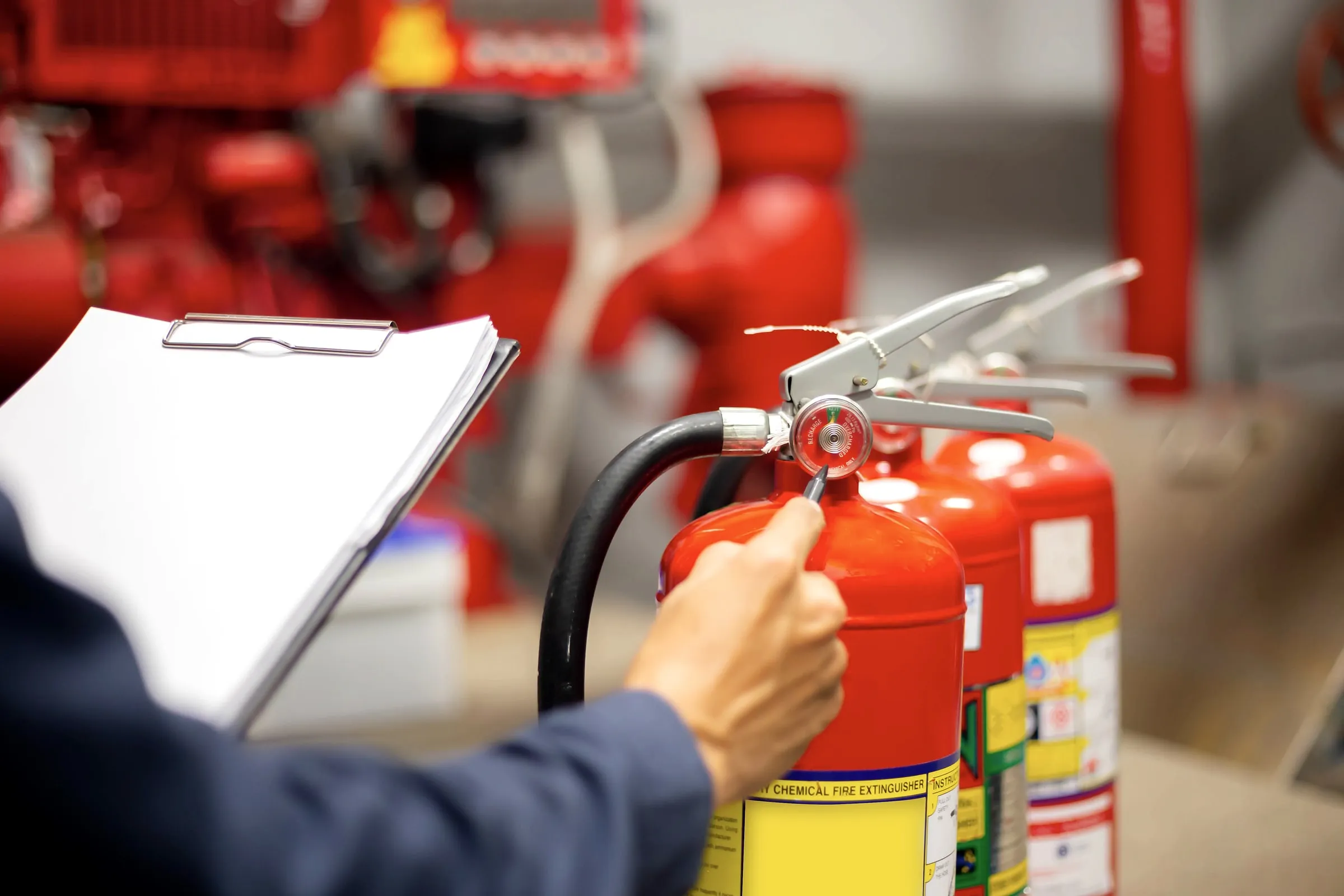
An extinguisher hanging on a wall bracket is only useful if it actually works when someone reaches for it, and a fire watch officer’s rounds include confirming that, not just noting that a red cylinder is present. The check is quick, a matter of seconds at each checkpoint, but it follows the same points every time, and what it finds gets written down whether the answer is good or not.
What the officer actually looks at
Presence first: is the extinguisher named for this checkpoint actually there, in its bracket or cabinet, not moved, missing or borrowed for another job on site. The pressure gauge, most commonly a needle dial, should read in the green operable range rather than in the red overcharged or undercharged zones. The pin and the tamper seal should be intact and unbroken, since a pulled pin means the unit has likely been discharged even if it looks full. The inspection tag, showing the date of the last professional service, should be current rather than expired. And the path to the unit should be clear: nothing stacked, parked or stored in front of it that would slow someone down in an actual fire.
Every round, not just the first one
A one-time check at the start of a watch tells the officer what was true when the watch began, not what is true three hours later. Conditions change during an impairment or a hot-work project: a contractor moves a unit to a work area and does not put it back, a gauge that read fine at the start drifts, a cabinet gets blocked by material staged for the next day’s work. Building the extinguisher check into every round, alongside the smoke and heat check the round already covers, catches these changes close to when they happen rather than at the end of a long watch when it is too late to matter.
| Check point | What a pass looks like | What a fail looks like |
|---|---|---|
| Presence | Unit is in its assigned bracket or cabinet | Missing, moved, or borrowed elsewhere |
| Gauge | Needle in the green operable range | Needle in the red, over or under charged |
| Pin and seal | Intact, unbroken, tamper seal in place | Pin pulled or seal broken |
| Inspection tag | Current, within the service date | Expired or missing entirely |
| Access | Clear path, unobstructed | Blocked by stored material, equipment or debris |
Whose extinguishers, and what happens if one is missing
On an impairment watch, the officer checks the building’s own existing extinguishers along the route, the ones already installed for the property’s general fire protection. On a hot-work watch, the extinguishers checked are the ones named on the permit, sometimes the contractor’s own portable units brought for the job, sometimes the building’s fixed units near the work area. Either way, if a required extinguisher turns out to be missing, expired or clearly unusable, the officer does not simply note it and move on; the finding goes to the coordinator on an impairment watch or to the permit’s authorizing individual on a hot-work watch, and work involving that checkpoint waits until it is resolved where the permit or the post orders require it.
What the officer does, and does not, do about a problem
Finding a low gauge or an expired tag is where the officer’s role in that moment ends; servicing, recharging or replacing the unit is a job for the building’s fire equipment contractor, not the fire watch. What the officer does is document the finding precisely, in the log, with the checkpoint, the time and what was observed, and communicate it to whoever can act on it. A unit that is visibly damaged, clearly discharged or entirely missing from a required location is treated as urgent and reported immediately rather than waiting for the round to finish, since it represents a real gap in the building’s readiness for the length of the watch.
Matching the extinguisher to the hazard
Not every extinguisher suits every fire, and part of the check is confirming the right type is where it needs to be, not just that some unit is present. A mechanical room with electrical panels needs a unit rated for electrical fires nearby, not only a water-based unit meant for ordinary combustibles. A hot-work location cutting or welding near flammable liquids needs an extinguisher rated for that hazard within reach, which is exactly why a hot work permit typically names the extinguisher required rather than leaving it to whatever happens to be closest. An officer who finds a unit present but mismatched to the hazard at that checkpoint reports it the same as a missing one, since the wrong extinguisher in an emergency can cost time that matters.
Extra units brought in for a specific job
Contractors doing hot work sometimes bring their own portable extinguishers rather than relying solely on a building’s fixed units, particularly for work happening away from where a building’s units are mounted, on a roof, in a yard, or deep inside a mechanical space. When that happens, the officer’s check covers those units the same way it covers the building’s own: gauge, pin, tag if the unit carries one, and placement close enough to the work to actually reach the fire in the first seconds. A contractor’s unit that gets moved with the crew from one location to the next is re-checked at each new location rather than assumed to still be in place from where it started the day.
How it shows up in the log
Extinguisher status is part of the standard round entry alongside exits and equipment, not a separate report filed only when something is wrong. A clean round notes the checks were made and passed; a round that finds a problem notes exactly what and where, and a follow-up entry records when it was resolved and by whom. Read together, a completed log shows not only that fire was watched for, but that the building’s own equipment was verified ready for the whole length of the watch, which is often exactly what an inspector or an adjuster is looking to confirm.
Questions
Related questions
Does the officer test the extinguisher during a check, or just inspect it?
Inspect, not test. Discharging even a small amount empties an extinguisher and takes it out of service, so the check is entirely visual and physical: gauge reading, pin and seal, tag, mounting and access. Testing and servicing extinguishers is a separate function performed by a licensed fire equipment company, not part of a fire watch round.
What if an extinguisher's inspection tag has expired?
It is logged as a finding and reported the same as a low gauge reading or a missing unit. An expired tag does not necessarily mean the extinguisher will not work, but it means nobody has confirmed that recently, and the coordinator or the building's maintenance contact is the one who arranges for it to be serviced.
Do officers carry their own extinguisher, or rely on the building's or the permit's?
A fire watch officer relies on the extinguishers named for the location, the building's existing units on an impairment watch, or the ones the hot work permit specifies. Officers are trained to use whichever extinguisher is on hand, and the check at the start of a watch confirms those units are actually there and ready.
Does a missing extinguisher stop hot work from starting?
It should. If a hot work permit names extinguishers that are not actually on site, the officer raises it with the authorizing individual before the first arc rather than allowing work to begin without the equipment the permit requires. The same applies mid-project if a unit is later found missing or discharged.
Related pages
Services
Insights
Glossary
Request a proposal
Request a proposal for your property.
Two short steps. Dispatch reviews every request and calls you back about coverage. For urgent unarmed coverage we can typically staff most sites within hours.
24-hour dispatch
(281) 326-9189