
Fire watch and compliance
How Fire Watch Rounds Work: Intervals, Routes and Checkpoints
By Price Protection SecurityReviewed TX DPS Lic #B09430601
Short answer
A fire watch round is built from three decisions: the interval, how often the route repeats, set by the fire marshal, the insurer or the impairment coordinator from the building's risk; the route itself, a sequence of checkpoints chosen to reach every part of the affected area; and the verification method, usually a timed log entry or a checkpoint scan, that proves the round happened. Hot work has no interval at all; the officer stays continuously at the work.
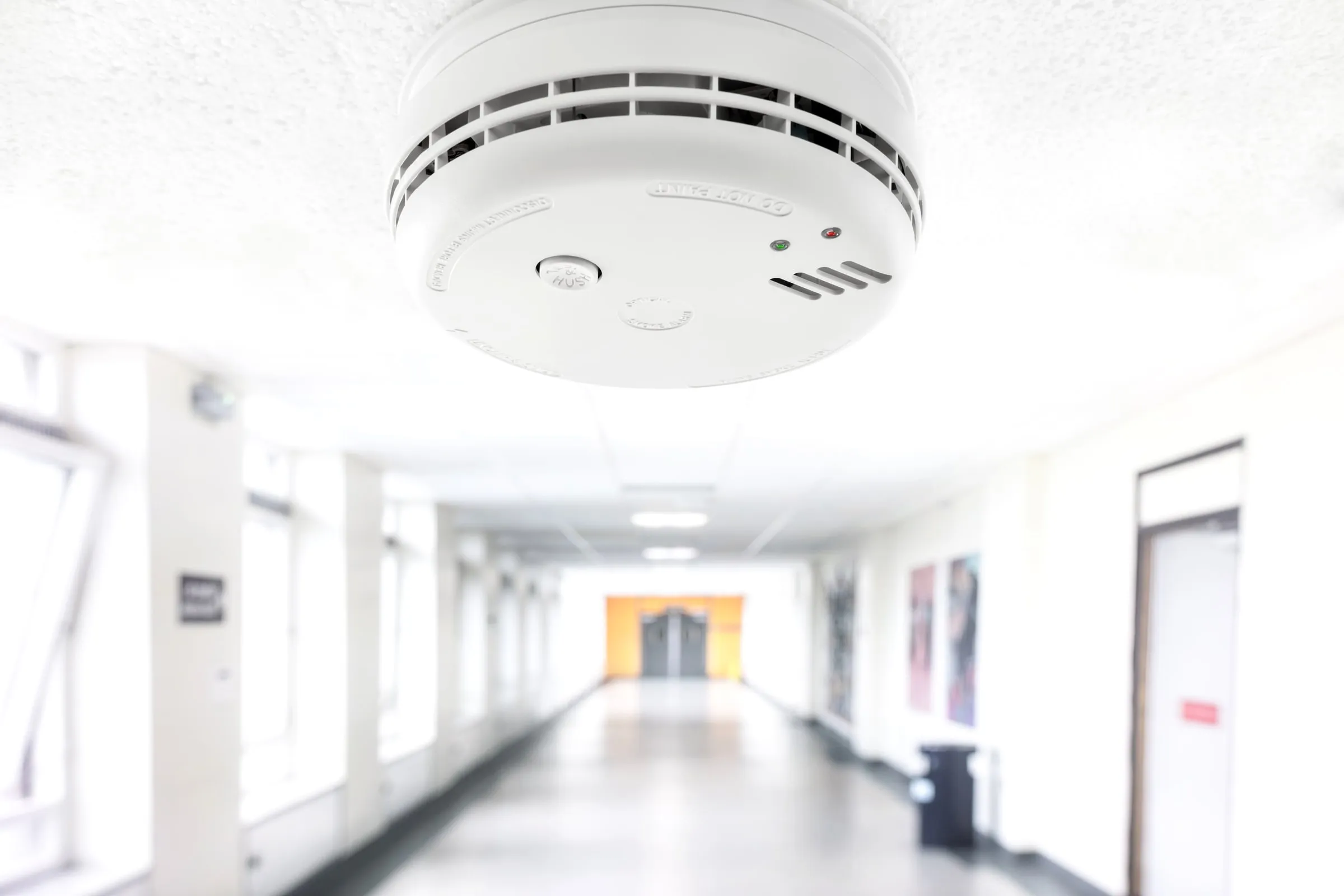
Two buildings with the same square footage and the same impairment can need very different fire watch rounds. One has a single open floor plate with clear sight lines and one riser; the other has a maze of storage rooms, a parking structure and three stairwells. Both get a route, an interval and a way to prove the round happened, but what those three things actually look like depends entirely on the building, not on a standard schedule applied everywhere.
Who sets the interval, and from what
The interval, the time between the start of one round and the start of the next, is set by the authority having jurisdiction where it gives a specific number, and by the impairment coordinator from the building’s own fire plan and the insurer’s requirements where the authority has not. In Houston, the Fire Marshal’s Office decides for a given building whether it wants rounds every fifteen minutes, every hour, or on some other schedule, based on the occupancy, the size of the impaired area and what is at risk. A hospital wing with patients who cannot self-evacuate typically gets a tighter interval than a low-occupancy storage building with the same square footage. Hot work has no interval at all in this sense: the officer’s post is continuous, at the work itself, for as long as it continues and through the post-work period after.
A route is a sequence of checkpoints, not a floor plan
The route is the order in which the officer walks the areas the impairment affects, and a good route is built around checkpoints, specific, identifiable points the officer physically reaches, rather than a general instruction to “check the third floor.” A checkpoint sits where it proves the officer actually entered a space and looked around: inside a mechanical room near the equipment, at the landing of a stairwell rather than just its door, at the far end of a dead-end corridor where a fire could develop unseen the longest. Storage rooms, electrical closets, trash chutes and any space that does not get regular foot traffic from building staff get their own checkpoint, because those are exactly the places a hazard can sit unnoticed between rounds.
Loop routes and why the sequence matters
Most routes are built as a one-way loop rather than a back-and-forth path, so that a timed log or a checkpoint scan shows a clear, checkable sequence: checkpoint one at a known time, checkpoint two a consistent number of minutes later, and so on around the loop back to the start. A guard tour system, a device or app that records the exact time an officer scans a tag at each checkpoint, makes this sequence auditable to the minute; a paper log recreates the same idea by hand, with the officer noting the time at each stop. Either way, a loop that always runs in the same order, varied only enough that it cannot be predicted by someone planning around it, is easier for a supervisor to verify than a route that changes shape every round.
| Watch type | Interval | Route shape |
|---|---|---|
| Sprinkler or alarm impairment | Set by the authority or the coordinator, often 15 to 60 minutes | Loop through every affected floor or zone, checkpoint at each risk area |
| Hot work | None; continuous presence | Fixed post at the work and the spaces sparks can reach |
| Post-work period after hot work | Continuous through the required window | Same footprint as the hot-work post, watching for delayed ignition |
| Large or multi-building impairment | Set per zone; may differ across the site | Split into separate routes per officer, coordinated by a supervisor |
Between rounds
On an impairment watch, the officer is not walking every minute of the interval; between rounds the post orders place the officer somewhere useful, usually a point with a view of the most exposed area and near the phone or radio used to raise the alarm, available to the coordinator and to anyone on site who needs to reach the watch. On a short interval, the gap between rounds can be brief enough that the officer is nearly always walking; on a longer one, the officer has real time stationed at that point, which is also when routine checks like a call to dispatch or a note in the log happen.
Verifying the round actually happened
The point of an interval and a route is worth nothing without proof they were followed, which is why every checkpoint produces a timed entry, whether scanned electronically or written by hand. A supervisor reviewing the log or the tour system’s export can see at a glance whether the gaps between checkpoints match the interval, whether any checkpoint was skipped, and whether the sequence held steady through a shift change. A round that shows every checkpoint at exactly the same time every hour, to the minute, is itself worth a second look, since real rounds vary slightly with what the officer finds along the way.
Adjusting the route mid-watch
Routes are not fixed once written. A contractor’s work area that moves from one riser zone to another, a stairwell that gets locked for an unrelated reason, or a coordinator who decides a checkpoint needs to move closer to a newly discovered hazard all change the route, and the post orders describe how those changes are made and recorded so the log stays an accurate record of what was actually walked, not a copy of the original plan.
Multi-officer routes on a large impairment
A single riser closure in a small building is one route for one officer. A whole-floor or whole-building impairment in a high-rise, or a large warehouse where one loop would take longer than the interval allows, needs the route split between two or more officers, each covering a defined section with its own checkpoints. A supervisor draws the split so the sections do not overlap unnecessarily and so each officer’s loop still returns to a point where they can be reached, and the log combines all the sections’ entries into one record so the coordinator sees the whole building’s coverage rather than piecing together several separate logs by hand.
Timing the first round before committing to an interval
Before a supervisor confirms an interval with the coordinator, the first round is usually timed as a trial: walking the proposed route with a watch or a phone, checkpoint to checkpoint, to see how long it actually takes against how long the interval assumes it should take. A route that is meant to run every fifteen minutes but takes twelve minutes to walk leaves the officer almost no time stationed between rounds, which is workable for a short watch but exhausting for one running multiple shifts. A route that takes six minutes against a fifteen-minute interval has room to spare, which a supervisor might use to add a checkpoint the first draft missed rather than leaving the officer standing idle. This trial walk is a small step that prevents an interval from being set on paper without ever being tested against the building it is meant to protect.
Questions
Related questions
Can a guard tour system replace a paper log for a fire watch?
Often, yes, where the authority and the coordinator accept it. A guard tour system records the exact time an officer scans each checkpoint, which can be more precise than a handwritten entry, but the building's fire plan and the fire marshal's expectations decide whether electronic records satisfy the requirement on their own or need a paper backup.
How is a checkpoint chosen inside a mechanical room or a stairwell?
At the point that best confirms the officer actually entered and looked around, not just passed the door: near equipment that could be a source, in the middle of a stairwell landing rather than only at its door, at the far end of a dead-end corridor rather than its entrance.
What happens if a round cannot be completed inside the set interval?
The officer tells the coordinator immediately rather than skipping part of the route to finish on time. The interval may need to be extended, the route split between two officers, or the area reduced; continuing to claim a full round in less time than it takes is what a false log looks like.
Does the route change if a contractor's work area moves during the day?
Yes, and it should. A hot-work route follows wherever the current permit is active, and an impairment route follows whichever zones the contractor has isolated at that hour. The post orders describe how to update the route rather than locking it to a fixed floor plan.
Related pages
Insights
- How to Keep a Fire Watch Log That Passes Inspection
- Impairment Coordinators: The Role Every Building Should Assign
- Who Is Qualified to Perform a Fire Watch in Texas?
- Fire Alarm Outages: When a Fire Watch Is Required
- Fire Extinguisher Checks During a Fire Watch
- Fire Watch After a Fire: Securing a Damaged Building
Glossary
Resources
Request a proposal
Request a proposal for your property.
Two short steps. Dispatch reviews every request and calls you back about coverage. For urgent unarmed coverage we can typically staff most sites within hours.
24-hour dispatch
(281) 326-9189