
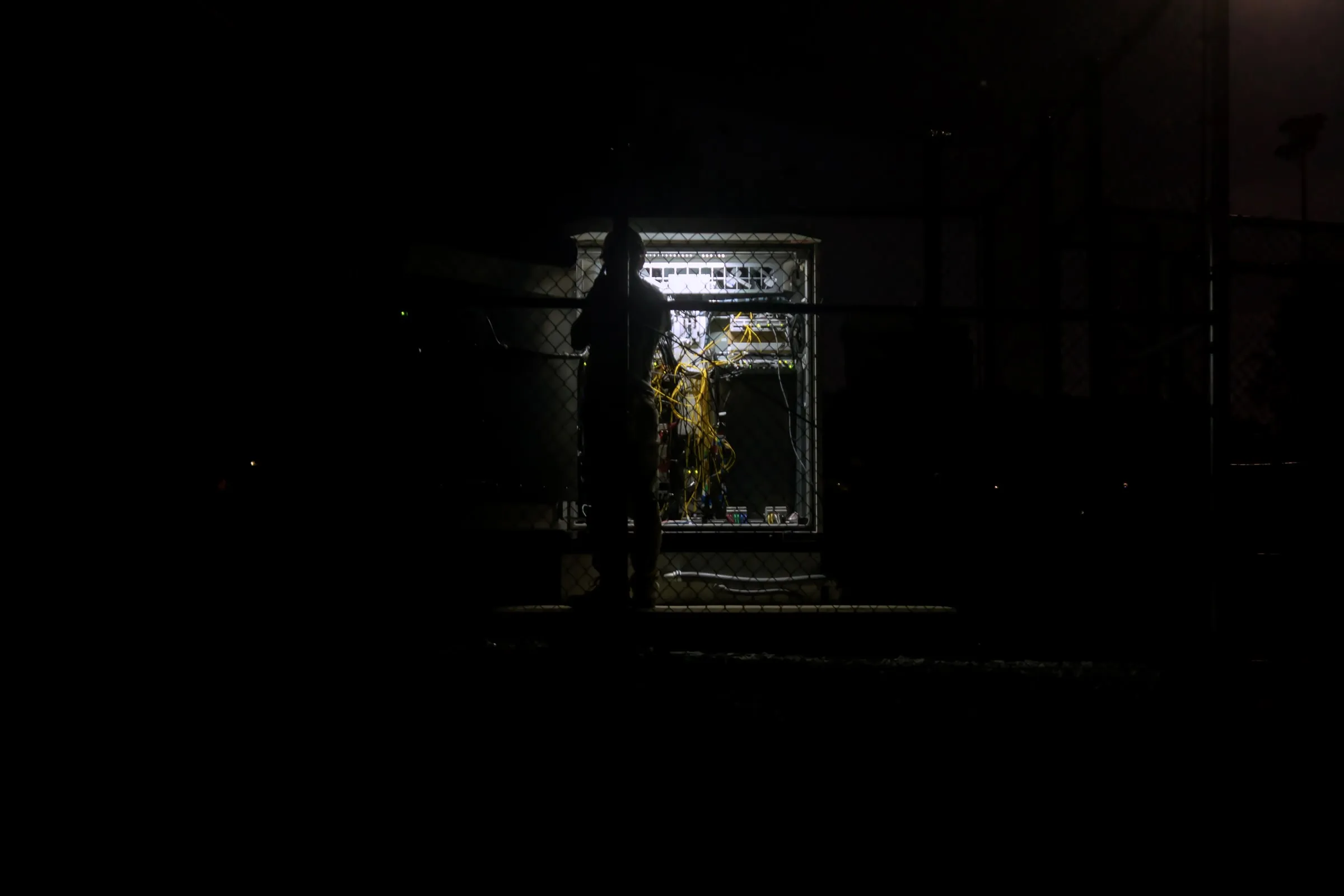
Security Guards for Telecommunications Facilities
An officer who admits a technician on a work order and nothing less, walks the generator yard every round, and keeps the NOC informed in writing.
Request a proposalThe situation
Why a network facility is staffed differently from an office
The building must never go dark
A switching center or network hub carries traffic for customers who notice an outage in seconds. The generators, fuel tanks, transfer switches and battery strings that keep it up sit in a yard or a lower floor that most people in the building never see.
Access is granted by work order, not by face
Carrier technicians, tower crews, HVAC vendors and fiber splicers arrive at all hours, often from companies the facility manager has never met. The only reliable check is the work order or access ticket the NOC issued, and someone has to read it.
Copper, batteries and fuel at remote sites
Equipment yards, huts and cell sites hold copper cable, backup battery strings and diesel, usually behind a fence with no one inside it. Theft there does not just cost the hardware, it drops the site.
Several carriers under one roof
A carrier hotel or shared hub houses competing companies on different floors or in different cages, each with its own access list. A technician cleared for one cage is not cleared for the next, and the officer is the only person who sees them all.
A building that must never go dark
A switching center looks like an office from the street and runs like a power plant inside. Its value is uptime, and uptime depends on a generator yard, fuel tanks, transfer gear and battery strings that are easier to reach than the equipment floors they protect. The officer’s rounds are built around that dependency: the yard and the fill point on every round, the battery room door checked, the chiller plant looked at, and a fault called to the NOC before it becomes an outage. The entry post is where the day’s tickets are checked, but the rounds are where the building’s weak points are.
Access by work order
A telecom facility admits people the facility manager has never met, from companies that change with every contract. The only check that holds is the work order or access ticket the network operations center issued. The officer reads it: name, company, ticket number, the floor or cage it covers, the window it is valid for. A ticket that has lapsed or names a different suite is a hold, and the officer calls the NOC rather than deciding at the door. The visitor and contractor check-in article explains how that procedure is written into post orders; here the ticket replaces the host’s phone call.
Carrier hotels and shared floors
Where several carriers share a building, the officer holds several access lists and admits each technician only to the area their ticket names. The building owner’s escort rules decide whether the officer walks the technician to the cage or hands them to the carrier’s own staff, and either way the escort is logged with times. Competing carriers in one building want a neutral post at the door, and that is what a contract officer working from written orders provides. Where the client gives the officer access to its own badge system, the badge system answer explains how provisioning and revocation stay with the client.
Remote yards, copper and batteries
Tower companies and carriers run huts, equipment yards and cell sites across Houston that nobody staffs. Copper cable, backup batteries and diesel are the targets, and the loss takes the site down as well as costing the hardware. A marked vehicle on a varied route checks fences, gates, battery cabinets, cable trays and fuel gauges, with a photograph at each stop and an immediate call to the NOC for anything open or missing. The route and the stop list are agreed with the client and can grow as sites are added.
Working with the NOC
The NOC watches the network; the officer is its presence on the ground. The post orders set out what the officer reports by phone or radio at once, what goes into the written report, which alarms the officer responds to and how, and when the police or fire department are called instead. The security operations center glossary entry describes how a client’s control room and an on-site officer divide the work. Price Protection’s own dispatch desk answers around the clock and is the officer’s second line when the NOC is busy.
Starting at a network facility
Dispatch needs the access ticket process, the carrier or tenant access lists, the generator and fuel yard layout, the remote site list if a patrol route is wanted, and the NOC’s contact and escalation path. A supervisor walks the facility with the critical-facilities team, the post orders are written and approved, and the first shift starts on the agreed date with the NOC introduced to the officers who will be calling it.
How we cover it
Every service, applied to this post.
- Unarmed security guards
An unarmed officer holds the lobby or the entry vestibule of the switching center through all three shifts, reading each access ticket against the NOC's list, issuing visitor badges under the facility's rules, and escorting where the ticket requires it.
- Access control
Every technician is matched to a work order or access ticket by name, company, ticket number and the floor or cage it covers. A ticket that has expired or that names a different suite is a hold, and the officer calls the NOC rather than making a judgment call at the door.
- Camera monitoring
From the entry post the officer watches the facility's own cameras on the generator yard, the fuel fill point, the loading area and the cage corridors, and uses them to time rounds and to confirm a technician went where the ticket said.
- Vehicle patrol
For a carrier or tower company with remote huts, equipment yards and cell sites around Houston, a marked vehicle runs a route of fence and gate checks, battery cabinet and copper inspection, fuel level notes and lighting faults, with a photo at each stop.
- Incident reporting
The daily report goes to the facility manager and, where the client wants it, to the NOC shift lead: tickets checked and holds made, escorts by cage and time, generator and fuel yard findings, remote site rounds, alarms responded to, and any door or camera fault.
A typical post
What a shift looks like here.
The evening officer takes the entry post from the day officer with the open tickets for the night: a fiber splicer due at ten for a cage on the third floor, an HVAC vendor on a standing ticket for the chiller plant, and a carrier technician whose ticket expired that afternoon. When the carrier technician arrives, the officer holds them in the vestibule, calls the NOC, and either admits them on a renewed ticket or logs the refusal with the NOC's name.
Rounds leave the entry post covered by the second officer where the facility has two, or run between tickets where it has one, and they always include the generator yard and the fuel fill point: enclosure locks, fuel cap seals, signs of tampering, lighting, and the battery room door. A finding goes to the NOC by radio or phone at once and into the report in writing.
On a remote-site route, the patrol officer stops at each hut or yard, checks the gate lock and the fence, inspects the battery cabinets and the cable trays for cut or missing copper, notes the generator fuel gauge, photographs the site, and reports a fault or an open gate to the NOC before moving to the next site.

Reporting
What the daily report covers here
Every client receives a written report each day, and officer performance is reviewed and documented daily. This is what the report records on this kind of post.
- Work orders and access tickets checked, with ticket number, company and area
- Entries held or refused, with the NOC contact who made the decision
- Escorts to cages and suites, with time in and time out
- Generator yard, fuel fill point and battery room checks, with findings
- Remote site rounds, with gate, fence, copper and fuel observations by site
- Alarms received from the NOC and the response, with times
- Door, camera and lighting faults reported to facilities
Questions
About telecommunications facilities coverage.
Anything else? Call dispatch at (281) 326-9189.
Can the officer verify a technician against a work order?
Yes, that is the core of the post. The NOC or facility manager gives the officer the access ticket list in whatever system the facility uses, and the officer matches name, company, ticket number and area before admitting anyone. A mismatch is a hold and a call, not a wave-through.
How do you handle technicians from several carriers in one building?
Each carrier's access list is kept separate in the post orders, and a technician is admitted only to the floor, suite or cage their ticket names. Where the building owner requires escorts between the lobby and the cage, the officer or the carrier's own staff provides it and the escort is logged with times.
Do you patrol unstaffed remote sites?
Yes. A marked vehicle runs a route of huts, equipment yards and cell sites on a schedule the client sets, with a fence and gate check, a copper and battery inspection, a fuel note and a photo at each stop. The route varies so the pattern is not predictable.
What does the NOC get from the post?
A phone or radio call for anything that needs action now, and a written daily report for the record: tickets checked, holds, escorts, yard findings, alarms and faults. Where the NOC uses a ticketing system and gives the officer access, entries can be logged there as well.
Can the officer respond to an alarm the NOC sees after hours?
Yes. The post orders set out which alarms the officer responds to, the route and the safety rules for each area, and when to call the police or the fire department instead. The officer confirms the response to the NOC and records what was found.
Related pages
Industries we serve
Service areas
Request a proposal
Request a proposal for telecommunications facilities.
Two short steps. Dispatch reviews every request and calls you back about coverage. For urgent unarmed coverage we can typically staff most sites within hours.
24-hour dispatch
(281) 326-9189