
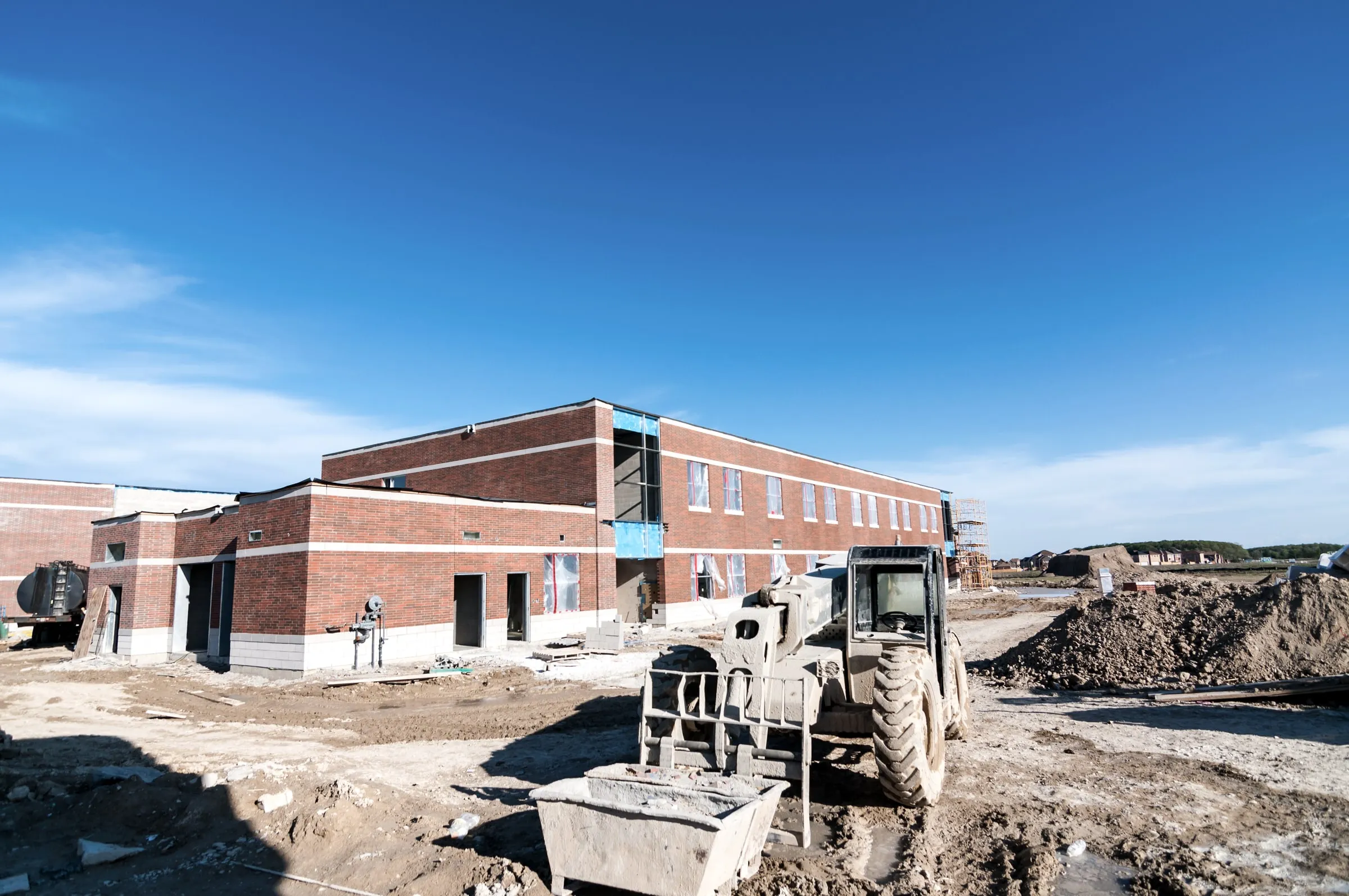
Security for School and Public Works Construction
The campus stays in session while the addition goes up next door. We keep the work zone separate from students and staff, every day it matters.
Request a proposalThe situation
What changes when the client is a district or a city, not a private owner
A work zone beside a campus still in session
A classroom addition, a renovation or a new gymnasium is frequently built while the rest of the campus continues to hold classes. The fence line between the work zone and the school has to hold up against students taking a shortcut as much as against anyone trying to get in from outside.
Every crew member needs a reason to be there
Public school and municipal projects generally require contractors to track who is on a campus at any time, sometimes with background screening for anyone working near students, and the site's sign-in process has to satisfy the district's requirements, not just the general contractor's own.
A public project draws public attention
Bond-funded school and public works projects are paid for by local taxpayers who take a direct interest in how the money is spent and how the site is run, and a public meeting or a news inquiry about the project is a normal part of the job in a way it rarely is for a private client.
Summer is the busiest season, not the quietest
Districts push as much work as possible into summer break when the campus is empty, which means the most intense construction activity, and the highest material and equipment exposure, happens during exactly the weeks the school itself is least staffed to notice a problem.
Construction beside a campus still in session
A school addition, renovation or new municipal building is often built while the surrounding facility continues to operate. Classes still meet, buses still run, library patrons still come and go, and the construction work zone sits inside or beside all of that rather than on a separate, empty lot. Price Protection’s post for a project like this starts with the boundary: where the fence or the barrier between the work zone and the occupied campus sits, how it holds during the school day, and what happens if a student, a staff member or a member of the public crosses it, since the answer is not the same as it would be for a trespasser at a private commercial site.
The post orders are written with the general contractor’s superintendent and reflect whatever the district or municipal owner requires, which is often more than a private client would ask for: sign-in procedures that satisfy the owner’s own security policy, delivery windows that avoid drop-off and dismissal, and in some cases a credential or badge requirement for anyone on campus near students. The insight on contractor and visitor check-in procedures covers the general version of this process; a school or public works project usually layers the owner’s own rules on top of it.
A project the public is watching
Bond-funded school and public works projects are paid for by local taxpayers, and that changes the texture of the job in ways a private commercial project rarely sees: public meetings about the project’s progress, occasional press interest, and an owner who wants documentation that holds up to scrutiny, not just a report that satisfies the general contractor. The daily report on a project like this is written knowing it may be read by someone outside the immediate project team, and incidents are documented completely rather than summarized.
Summer is the construction season
For an active school, the calendar runs backward from a typical job site’s. The slowest months for construction elsewhere are the busiest for a school project, because districts push as much work as possible into the weeks students are away. During that window the whole campus effectively becomes the work zone, deliveries and equipment move without the drop-off and dismissal constraints that shape the rest of the year, and the exposure to material and equipment loss rises with the pace of the work. Coverage is typically increased for the summer push and scaled back once students return and the boundary-focused school-year post resumes.
Working with the district and the general contractor
Two parties read the report on a project like this: the general contractor’s superintendent, who is running the job day to day, and the district or municipal facilities office, who owns the building and answers to the public for it. The post orders are written to satisfy both, which usually means more documentation, not less, and a willingness to explain the boundary and the access process to whichever party asks.
Starting a post at a school or public works project
To begin, dispatch needs the site address, the school or facility’s calendar including any planned closures, the general contractor’s delivery and crew schedule, and any credentialing or background check requirement the district has in place. An unarmed officer can typically start within hours for an urgent need, with the boundary between the work zone and the occupied facility set from the first shift.
How we cover it
Every service, applied to this post.
- Unarmed security guards
An unarmed officer controls the boundary between the active work zone and the rest of the campus during the school year, checking that gates separating construction from student areas stay closed and that the crew's access does not drift into occupied parts of the building.
- Access control
Every contractor and delivery vehicle is checked against the day's list, and where the district requires it, the officer confirms that crew members working near occupied parts of campus carry whatever credential or badge the district's screening process issues.
- Vehicle patrol
On a public works project spanning more ground, a road, a utility corridor or a multi-building campus, a vehicle round covers the site faster than a fixed post and checks material and equipment staged across a larger footprint.
- Incident reporting
The daily report notes the boundary with occupied campus areas and any breach of it, contractor and delivery vehicles logged, material and equipment checked, and anything relevant to a public inquiry into the project, since these reports are sometimes requested by the owner for that reason.
A typical post
What a shift looks like here.
During the school year, the day officer's main task is the boundary: checking that gates between the work zone and the rest of campus are closed before students arrive and stay that way through the school day, and that deliveries are scheduled around drop-off and dismissal rather than crossing paths with them.
After students and staff leave for the day, the officer's rounds shift to the usual construction checks, material staged in the work zone, equipment secured, doors and gates locked for the evening, with the same attention to keeping the boundary intact overnight as during the day.
During a summer break push, the schedule changes entirely: the whole campus becomes the work zone, deliveries and equipment move throughout the day without the drop-off and dismissal constraints, and the officer's rounds cover a much larger footprint on a much more intense construction schedule.

Reporting
What the daily report covers here
Every client receives a written report each day, and officer performance is reviewed and documented daily. This is what the report records on this kind of post.
- Boundary between the work zone and occupied campus checked, by time
- Contractor and delivery vehicles logged against the day's list
- Crew credentials or badges checked where the district requires them
- Deliveries scheduled around drop-off and dismissal, any exceptions noted
- Material and equipment checked, by location on a multi-building site
- Any incident relevant to a public inquiry, documented in full
Questions
About school and public works construction coverage.
Anything else? Call dispatch at (281) 326-9189.
Does the site need background-checked officers because it is near a school?
Officer screening for a Price Protection post follows the same licensing and background check process required for every Texas security officer, and where a district has an additional requirement for anyone on campus, that requirement is confirmed with dispatch before the post starts so it is met from the first shift.
How does the schedule change during summer break?
Districts typically push as much construction as possible into the weeks students are away, which means the busiest, highest-exposure phase of the project often runs when the campus itself has the least staff on hand to notice a problem. Coverage is usually increased for that window rather than left at the school-year level.
Who do you report to on a public project, the contractor or the district?
The daily report goes to the general contractor's superintendent, who is the party managing the post, and a copy or a summary is made available to the district or municipal owner where the contract calls for it. Public projects are frequently more document-heavy than private ones for exactly this reason.
Can coverage be limited to after school hours only?
Yes, where the work zone is fully separated from the active campus during the day and the risk is mainly an after-hours one. Many school projects run daytime construction with the district's own procedures managing the boundary, and add a security post specifically for evenings, weekends and the overnight gap.
Do you cover municipal projects like libraries or public buildings the same way?
The same principles apply: a work zone beside a facility that may still be open to the public, a public owner interested in how the project is run, and a schedule that sometimes concentrates work into a closure window. The specifics of the post orders follow the building and the owner's requirements rather than a fixed template.
Related pages
Industries we serve
Service areas
Insights
Glossary
Resources
Request a proposal
Request a proposal for school and public works construction.
Two short steps. Dispatch reviews every request and calls you back about coverage. For urgent unarmed coverage we can typically staff most sites within hours.
24-hour dispatch
(281) 326-9189