
Security for Commercial Construction Sites
A new building going up beside stores that are still open. We keep the site gate and the customer lot separate and log every load between them.
Request a proposalThe situation
What makes a commercial site different from a stand-alone lot
A site with an audience
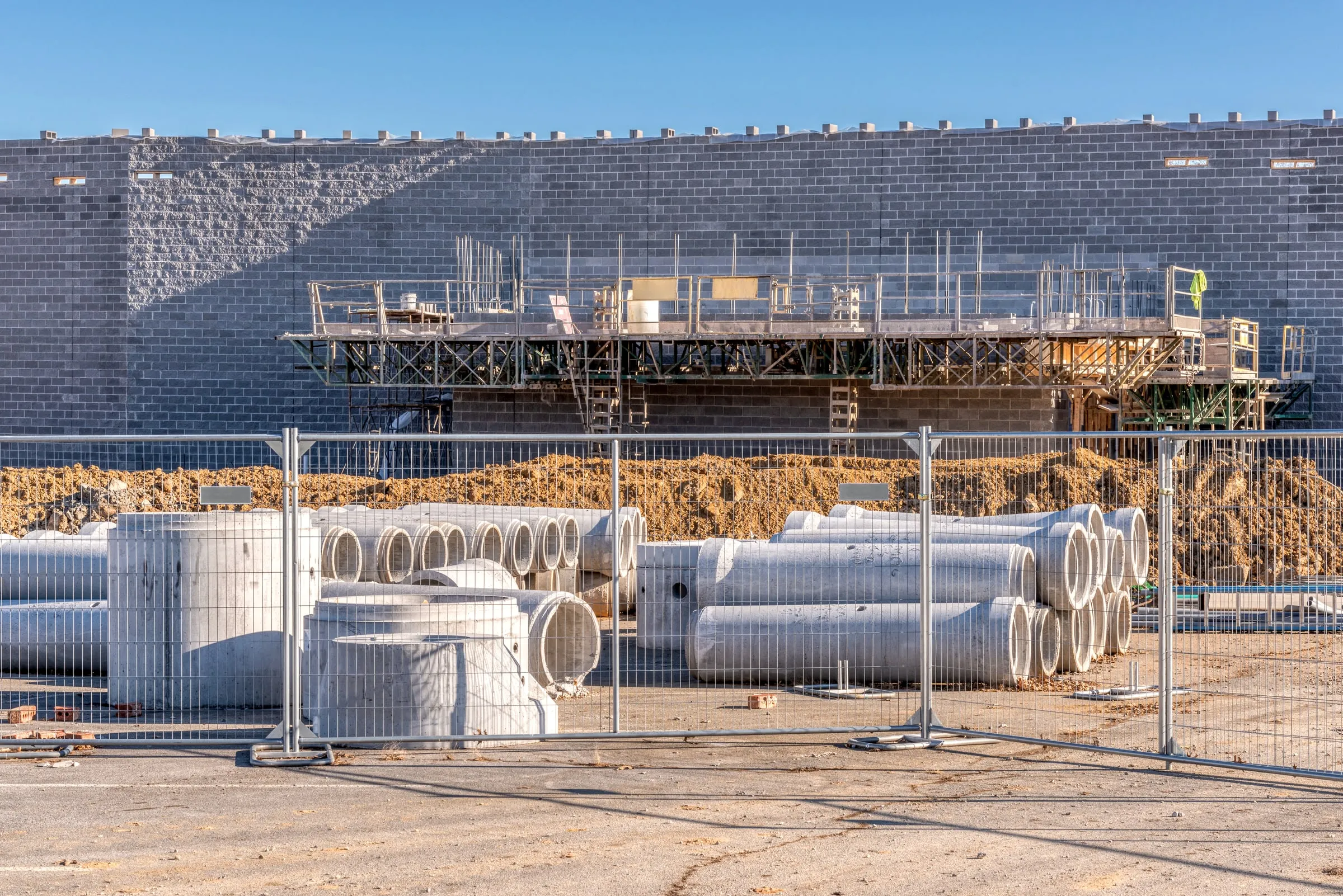
A new pad building or a shopping center expansion is often built while the stores around it stay open. Customers pull into the same driveway the concrete trucks use, park near the fence line, and a construction gate that looks like the store entrance sends the wrong traffic in both directions.
One developer, several contractors, several schedules
A commercial development frequently has more than one building going up at once, each with its own general contractor, its own crew and its own delivery schedule, all sharing the same access road and the same undeveloped land the developer has not yet fenced. A gate written for one contractor does not cover the site.
Storefront glass and rooftop units staged in plain sight
Storefront glazing, HVAC units and signage arrive finished and are staged near the building until the crane or the crew is ready, often within view of the parking lot and the road. It is the material closest to being valuable retail fixtures and the material least protected by a fence still under construction.
The handoff from shell to tenant space
Once the building is weathertight, the general contractor's crew thins out and tenant improvement subs begin arriving for the spaces that have leased. That gap, between the shell contractor stepping back and the TI crews taking over, is when access control is least defined and most needed.
A site with an audience
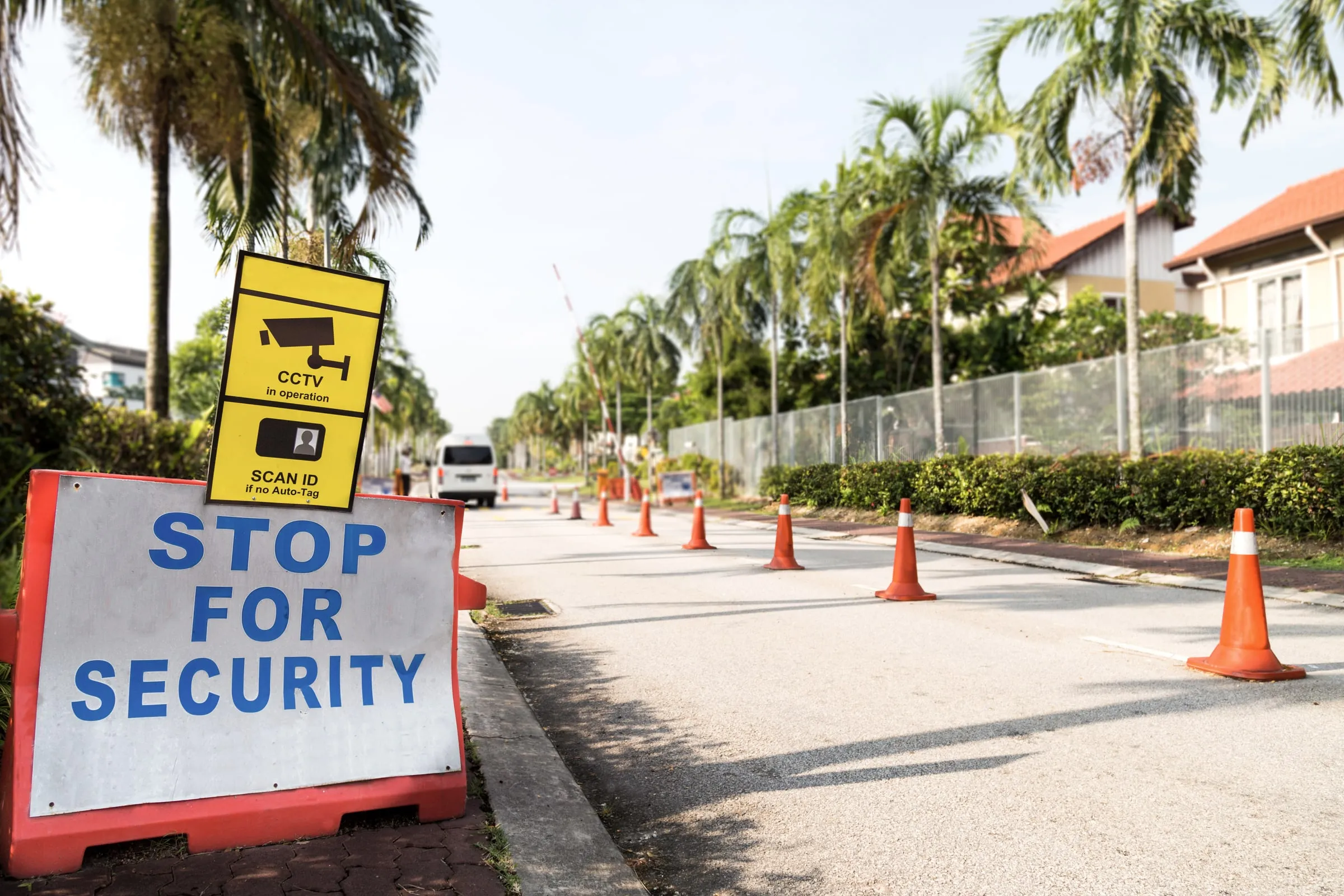
Most construction sites are separated from the public by distance. A commercial site rarely is. A new restaurant pad going up in front of an occupied shopping center, or a warehouse expansion beside a working distribution yard, sits within a few hundred feet of customers, employees and traffic that has nothing to do with the project and no reason to know where the construction gate is. Price Protection’s first job on a site like this is to make that boundary obvious: a gate that is not the store entrance, signage that sends the wrong car back the way it came, and an officer who can tell a customer from a delivery driver at a glance and treat each correctly.
The post orders are written with the developer or the general contractor’s site manager, and they cover more than the fence line. They record where the customer lot ends and the construction area begins, which access road the concrete trucks use, what happens when a delivery truck cannot fit and needs the customer lot for a few minutes, and who at the property management office gets called when a customer wanders into an active work area. A commercial site’s post orders read as much like a traffic plan as a security plan, because for the officer at the gate, they are one thing.
One developer, several contractors, several schedules
Where a single-family subdivision has one builder and a high-rise has one general contractor, a commercial development often has several: an anchor building under one contractor, two or three pad sites under others, all sharing a driveway the developer controls. The gate has to work for a schedule none of the individual contractors set. Price Protection asks the developer or the construction manager for a combined delivery and sub list, updated as each contractor’s schedule changes, so the gate is not calling three different superintendents to confirm three different trucks in one morning.
Keeping customers and the site apart
The riskiest hours are not always night. A weekday lunch rush at the stores next door puts more strange cars near the fence line than any 2 a.m. round will, and a customer who parks near the construction gate looking for a shortcut is as much a hazard to the site as a person there to take something. The officer’s post is positioned where both flows, customer and contractor, can be seen and separated, and the insight on hiring for a property manager’s needs covers the questions a developer typically asks before adding a post to an active retail environment.
From shell to tenant improvement
A commercial shell building is not finished when the general contractor demobilizes; it is finished when the last tenant improvement crew closes out. In between, the sign-in list changes from one contractor’s roster to a rotating set of TI subs arriving on their own schedules for spaces that have leased. Tenant improvement security covers that phase in detail; on a commercial development, the two phases usually overlap, with one pad still under shell construction while another is already in tenant buildout.
Starting a post on a commercial development
To begin, dispatch needs the site address or development name, the developer’s or general contractor’s delivery schedule, a site plan showing which pads are active, the customer lot boundary and a contact for the property management office. An unarmed officer can typically start on a commercial site within hours, with the gate and the customer boundary set from the first shift so neither the crew nor the neighboring stores have to work around confusion later.
How we cover it
Every service, applied to this post.
- Unarmed security guards
An unarmed officer at the construction gate, separate from any customer entrance the development already has, checks vehicles against the day's delivery and sub list and directs anyone looking for a store to the correct driveway instead of waving them through the site.
- Access control
Every contractor vehicle and delivery is logged in and out, with the load and the destination pad noted on a multi-building development. Where the developer has not yet fenced undeveloped parcels, the officer's rounds extend to those parcels so material is not simply set down on open land.
- Vehicle patrol
On a development with several pad sites or a large shopping center expansion, a vehicle round moves between buildings faster than a foot patrol, checking each site's staged material and fencing and reporting back to the main gate between passes.
- Camera monitoring
Where the developer or a contractor has cameras on a pad site, the officer checks them from the gate between vehicle checks, which matters most after the neighboring stores close and the lot empties out for the night.
- Incident reporting
The daily report separates activity by building where more than one is under construction, with deliveries logged by pad, material staged in the open noted by type, and any customer or public vehicle that entered the construction area rather than the store lot.
A typical post
What a shift looks like here.
The day officer opens the gate against the delivery schedule the general contractor's office sent overnight, and spends the morning directing trucks to the right pad while the neighboring stores open for business and their customers start filling the shared lot.
Through the afternoon the officer's attention shifts to the edges of the site: undeveloped parcels where material has been set down without a fence yet, the tenant improvement subs starting to arrive for spaces that have leased, and the gap between the general contractor's crew, which is thinning as the shell finishes, and the TI crews, which have not fully started.
After the stores close, the site is the only thing still lit on that stretch of road. The officer's rounds cover every pad under construction, check that storefront glass and rooftop units staged near the building are where they were left, and note anything moved before writing the report for the general contractor's site meeting the next morning.
Reporting
What the daily report covers here
Every client receives a written report each day, and officer performance is reviewed and documented daily. This is what the report records on this kind of post.
- Contractor and delivery vehicles logged, by pad site and load
- Customer or public vehicles found in the construction area, with the outcome
- Material staged in the open checked, by pad and type
- Undeveloped parcels checked for unfenced material or unauthorized use
- Tenant improvement subs signed in once a space is under buildout
- Fencing, gates and lighting found damaged or missing, by pad
The shopping center stays open during construction. How do you keep the two apart?
With a construction gate that is physically separate from the customer entrance and clearly marked, and by directing anyone who has come to shop, not to build, back to the correct driveway rather than letting them wander a site that looks finished from the road but is not. The post orders name the boundary the developer has agreed to.
There are three general contractors on this development. Who gives the post orders?
Usually the developer or the developer's construction manager, with each general contractor's schedule and delivery list folded into one set of orders for the shared gate. Where a pad has its own separately fenced site, that contractor's superintendent adds their own list for that pad specifically.
Does coverage change once the shell is finished?
Yes. As the general contractor's crew steps back, the risk shifts from bulk material and structural theft toward the finish items tenant improvement subs bring in, and the sign-in list shifts from one contractor's crew to a rotating set of smaller TI subs. We rewrite the access list at that point rather than leave it as it was for the shell.
What about material staged in view of the road?
It is checked on every round precisely because it is in view. Storefront glass and rooftop units left in the open near a public road are logged with a count at the start and end of the shift, and the officer's position at the gate is chosen so that staging area stays in sight between vehicle checks.
Related pages
Industries we serve
Service areas
Insights
Glossary
Resources
Request a proposal
Request a proposal for commercial construction.
Two short steps. Dispatch reviews every request and calls you back about coverage. For urgent unarmed coverage we can typically staff most sites within hours.
24-hour dispatch
(281) 326-9189