
Operations and reporting
Security for Late-Night Deliveries and Loading Docks
By Price Protection SecurityReviewed TX DPS Lic #B09430601
Short answer
A late delivery arriving outside staffed office hours is handled the same way at every property type: the officer verifies the driver and the paperwork against what was expected, logs the arrival and, where the site has one, the trailer or seal number, and admits or holds the delivery following the post orders. What differs is the setting, a warehouse dock with an appointment system, an apartment gate with no advance notice at all, and the post orders are written for that specific property's pattern.
The same procedure, applied to whatever the property actually receives
Every property that takes deliveries outside its own staffed hours faces the same basic problem: someone unfamiliar shows up at a gate or a dock with a truck, at an hour when the person who normally handles deliveries is not there to say yes or no. Price Protection’s answer is the same procedure everywhere, adjusted for what the property actually looks like. The officer verifies who is arriving and why, checks that against what was expected, logs the details, and either admits the delivery or holds it for confirmation. What changes from a distribution center to an apartment community is how much information exists to verify against, not the underlying discipline.
A distribution center or warehouse: verifying against an appointment
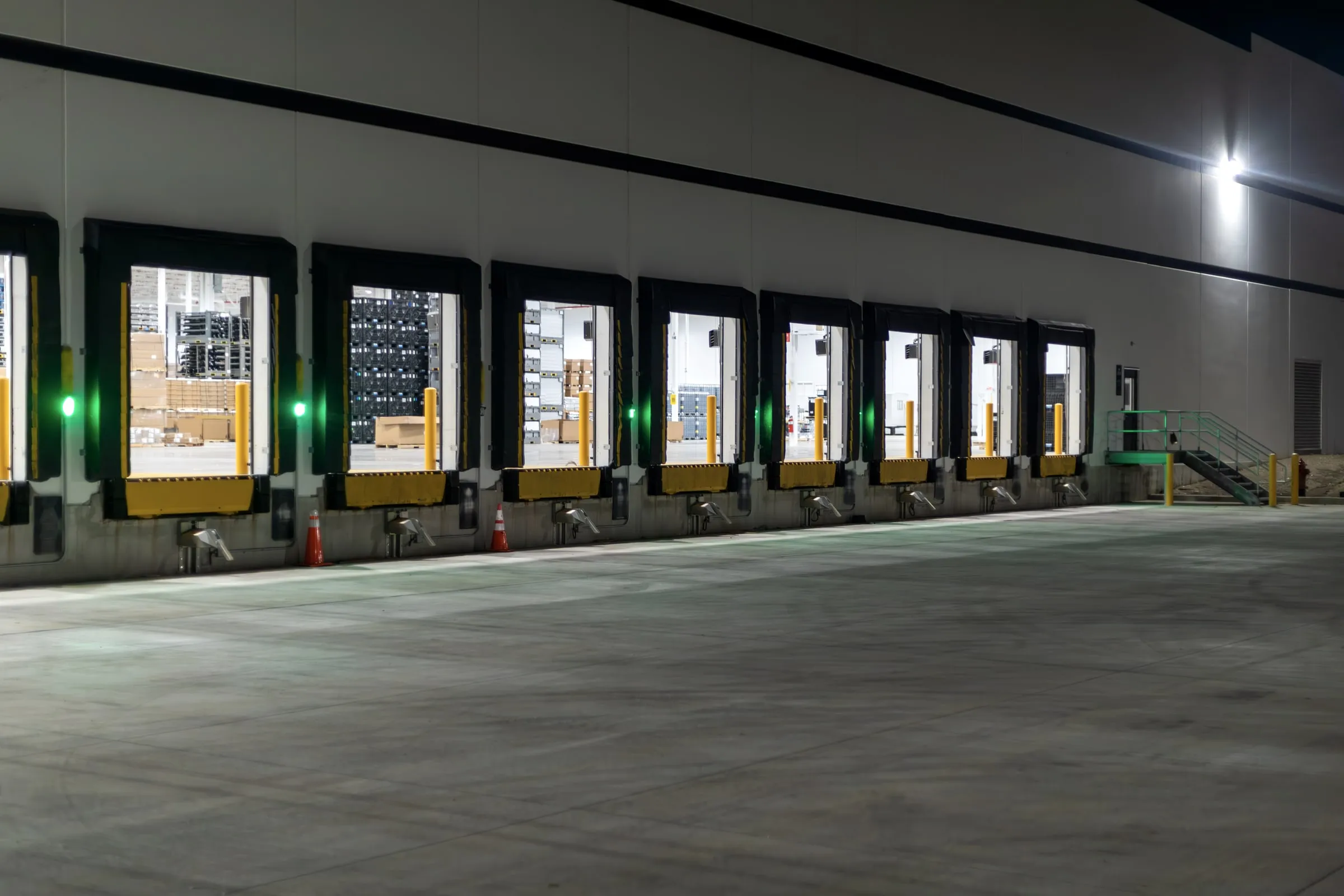
At a facility with a shipping and receiving operation, late deliveries usually arrive against a schedule, and the officer’s job is largely reconciliation: the driver’s credentials and paperwork are checked against the appointment on file, the trailer and seal numbers are logged in, and anyone not on the schedule waits at the gate while the officer confirms with the shipping office’s after-hours contact rather than guessing. Outbound trailers get the same treatment in reverse, with seal numbers logged out and checked against what was loaded. This log is what lets a missing pallet or a mismatched seal be caught the same night rather than discovered at inventory weeks later, and it is why the gate, not the yard, is often called the site’s first control.
An apartment community: verifying without an appointment system
An apartment community has no shipping office and usually no advance notice at all: a resident orders a late grocery delivery, a moving truck arrives after hours for an early start, a food delivery driver buzzes a gate at midnight. Here the officer works from whatever the property does provide, a call-ahead list where residents can register an expected delivery, the resident’s own confirmation by phone or intercom, or simple judgment about whether admitting a single driver to a specific building is consistent with the property’s access rules. Post orders for this kind of property usually draw a line between a driver dropping something at a leasing office or package room, which is routine, and a driver asking to be let past a controlled gate to a specific building, which gets a call to the resident first.
A retail or restaurant loading area: a narrower window, a known vendor list
Retail centers and restaurants that receive after-hours deliveries typically work from a known vendor list rather than an open appointment system: the same beverage distributor, the same produce supplier, arriving on a predictable schedule even if the exact time varies. The officer’s job here is recognizing the pattern, verifying the vendor against the list, and flagging anything that deviates from it, an unfamiliar company, a vehicle that does not match, a delivery at a time nothing is normally expected.
Comparing the delivery procedure across property types
| Property type | What the officer verifies against | How an unscheduled arrival is handled |
|---|---|---|
| Warehouse or distribution center | An appointment system and seal numbers | Held at the gate, confirmed with the shipping office’s after-hours contact |
| Apartment or residential community | A call-ahead list or direct resident confirmation | Held until the resident or the leasing office confirms |
| Retail center or restaurant | A known vendor list and a usual schedule | Flagged as unusual, confirmed before entry |
What gets logged every time, regardless of property type
Whatever the setting, the log records the same core information: who arrived, representing what company, what time, what they were there for, and when they left. Where the site tracks trailers, the seal number goes in the same entry. This is not paperwork for its own sake; it is what turns a driver the officer half-remembers into a fact the next shift, the property manager or, if something goes missing, an investigator can rely on. A gate with no log has no way to answer a simple question after the fact: did anyone come through last night, and who.
Holding a delivery is a normal outcome, not a failure
An officer who holds an unscheduled delivery at the gate while confirming it is doing the job correctly, even though it inconveniences a driver on a schedule of their own. Post orders set how that confirmation happens and how long a reasonable hold looks like, so the officer is not stuck making an unstructured judgment call at 2 a.m. about a stranger with a truck. Where a client wants deliveries admitted faster, the answer is usually a better call-ahead system or an expanded vendor list, not looser verification at the gate.
Shift change is when a dock is most exposed
At any facility running multiple shifts, the busiest and most vulnerable moment at a dock is not the middle of a quiet night; it is shift change, when a crowd of drivers, forklift operators and dock workers moves through the gate at once and a single officer has the least time to verify any one of them carefully. Post orders for a multi-shift operation usually staff the gate through that window specifically, sometimes with the patrol rounds paused or shortened so the officer’s attention stays on the gate rather than splitting between the two. The log still has to hold up under that volume, which is why properties with heavy shift-change traffic often move to a scanned badge or a simplified check against a daily roster rather than writing every name by hand in the moment.
Where this fits alongside the rest of the post
Late-night delivery handling is written into the post orders’ access rules section alongside visitor and contractor procedures, using the same contact tree for anything that needs confirmation outside normal hours. The warehouse security article goes deeper into the gate-and-yard structure at a logistics facility, and the visitor and contractor check-in article covers the broader access procedure this fits inside.
Questions
Related questions
What if a delivery shows up that nobody was expecting?
It waits. Post orders set who the officer calls to confirm an unscheduled arrival, whether that is a shipping office, a leasing office or an after-hours contact, and the driver is not admitted until it checks out.
Does the officer inspect what is inside the truck?
No. The officer verifies who is delivering, what the paperwork says, and, where the site tracks it, a seal number, but does not open or search a vehicle. Anything that looks wrong is reported, not investigated by the officer.
How is a late-night delivery at an apartment community different from one at a warehouse?
A warehouse dock has appointments, seals and a shipping office to verify against; an apartment community usually has none of that, so the officer works from resident notice, a call-ahead list, or simple observation rather than paperwork.
Are drivers logged the same way as any other visitor after hours?
Similarly, with an added layer specific to freight: the company, the load or trailer number, and the time in and out, on top of the name and purpose logged for any after-hours visitor.
Related pages
Industries we serve
Services
Insights
Request a proposal
Request a proposal for your property.
Two short steps. Dispatch reviews every request and calls you back about coverage. For urgent unarmed coverage we can typically staff most sites within hours.
24-hour dispatch
(281) 326-9189