
Operations and reporting
Camera Monitoring by Guards: Live Response vs Recorded Footage
By Price Protection SecurityReviewed TX DPS Lic #B09430601
Short answer
Live monitoring is an officer watching a property's own cameras during a shift and reacting to what appears: a propped door, a car circling a lot, a person where nobody belongs. Recorded footage is that same system's stored video, pulled afterward to write an incident report or hand to police. A post built around cameras uses live monitoring to catch things happening now and recorded footage to document what already happened.
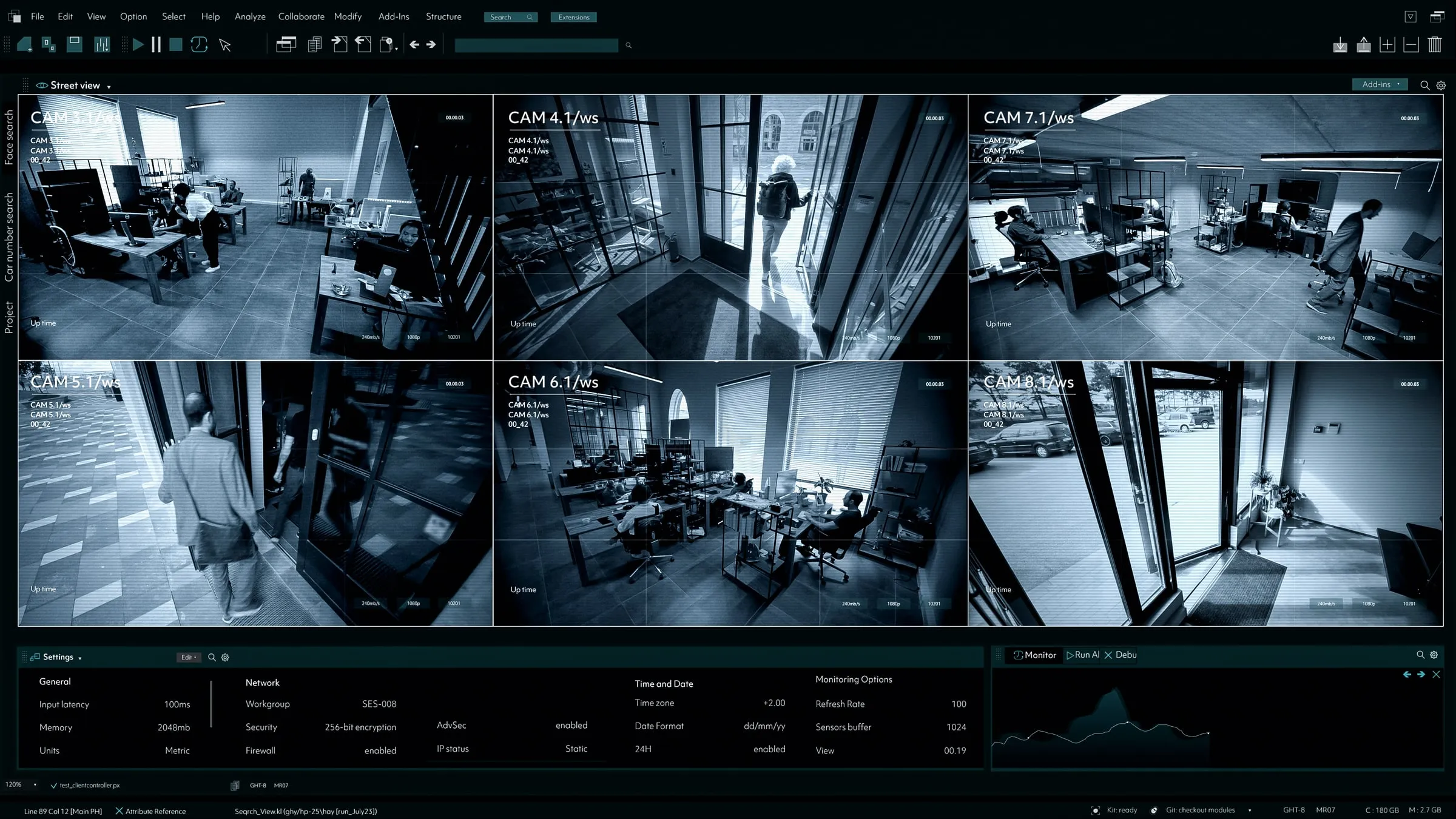
Live monitoring is a person acting, not a system recording
Live monitoring means an officer sits where the property’s monitors are, at a desk, a gatehouse or a leasing office, and watches them between rounds. The camera system itself only records; it does not decide anything. The officer is the part that decides. When a screen shows a car circling a lot for the third time, a door left open past closing, or someone climbing a fence line, the officer looks, walks over or calls it in, and the moment is handled while it is still happening rather than found later. That immediacy is what live monitoring adds that a camera alone cannot: a camera watched by nobody records an event; a camera watched by an officer gets a response.
Live monitoring also feeds the rest of the post. An officer who sees a knot of people gathering in a corner of a parking structure on the monitor can route the next round there first instead of waiting for the schedule. In that sense the cameras are a tool for deciding where to walk, not a replacement for walking.
Recorded footage does its work after the fact
Recorded footage is the property’s own stored video, held on a recorder or a cloud account the property controls, and it earns its keep once something has already happened and needs to be explained. A resident reports a car broken into overnight; the report includes an approximate time, and the recorded footage from that window is pulled to see what actually happened, who was on camera, and when. A trespasser is warned off a property on Tuesday and is back on Friday; the earlier footage backs up the trespass warning on file.
Recorded footage is also what turns a suspicion into a fact. An officer’s live observation is one person’s account of one moment; the recording is evidence that can be reviewed again, by a supervisor, by the property manager, or by police, without depending on memory. That is why an incident report cites the camera and the time rather than describing the footage from memory alone.
Where the two do different jobs
| Live monitoring | Recorded footage | |
|---|---|---|
| When it matters | While something is happening | After it has already happened |
| What it produces | An immediate response: a walk-over, a call, a warning | A record: a clip, a time, a reference for the report |
| Who uses it | The officer on the post, in the moment | The officer writing the report, the manager, sometimes police |
| Its limit | Only useful if someone is watching | Only useful if the system was recording and retention has not cycled it out |
Neither column stands in for the other. A property that only records has evidence after a loss but no chance to stop it; a property that is only watched live has quick reactions but no record to fall back on once the officer’s shift has ended and memory has faded. Price Protection posts that include camera monitoring are set up to do both.
What a post needs for live monitoring to work
The property supplies the system: working cameras, a monitor or workstation at the post, and a login that shows live views rather than only a playback screen. Post orders then record which cameras cover which areas, which views matter at which hours, such as the pool after closing or the garage overnight, and what the officer does with what is seen: walk over, call the manager, call police, or simply note it and keep watching. Without that direction, an officer watching six or eight feeds has no way to know which movement matters and which is routine. The walk-through is where a supervisor and the client work out that priority list together, camera by camera.
What recorded footage needs to be useful later
A system that records but that nobody can search quickly is nearly as unhelpful as no recording at all when an incident report is due the same day. Post orders should say how far back the officer can pull footage, how a clip is exported, and what happens to that export once it is attached to a report. Retention is the property’s setting, not the officer’s choice, and an officer who knows the retention window can flag an incident early enough to save footage before it cycles out on its own schedule. Where a property’s cameras cover common areas that residents or the public also use, the same policy that governs monitoring governs what gets described in a report: what is relevant to the incident, and nothing about people going about their business who are not part of it.
Using both without leaning on either alone
The property that gets the most out of a camera system is the one that treats it as one input among several, alongside the officer’s own rounds, the access log and the daily report, rather than as a stand-in for a person on the ground. A screen full of quiet feeds is not the same as a property with no problems; it can just as easily mean the officer has not looked in a while, or that the angle that matters is the one camera nobody thought to point at the loading door. Live monitoring keeps the officer’s attention on what the cameras show right now; recorded footage makes sure that when a manager or a resident asks what happened, the answer is not a guess. Reviewing the camera monitoring guards post description shows how the two functions sit inside a single shift, and the cameras go down article covers what changes when the system itself fails.
Questions
Related questions
Does watching cameras replace walking rounds?
No. A camera shows what its lens covers; a round covers everything else, including a smell of smoke, a jammed latch, or a person a camera angle misses. Post orders set both, and neither substitutes for the other.
How long is recorded footage kept?
That is set by the property's own system and its retention policy, not by the officer. The officer's job is to know what the system keeps and for how long, and to flag anything that needs to be saved before it cycles out.
Can an officer export a clip for a police report?
Where the property's system allows it and the property's policy permits sharing, yes, as part of the incident report. The export is logged: who requested it, what it shows, and where it went.
What if the officer is doing rounds when something happens on camera?
Recorded footage covers that gap. The officer reviews it at the next desk check or on return, and anything significant still gets an incident report with the camera reference and the time it was found, not just the time it happened.
Related pages
Industries we serve
Services
Insights
Glossary
Request a proposal
Request a proposal for your property.
Two short steps. Dispatch reviews every request and calls you back about coverage. For urgent unarmed coverage we can typically staff most sites within hours.
24-hour dispatch
(281) 326-9189