
Licensing, training and the law in Texas
Can Security Guards Legally Carry Guns in Texas?
By Price Protection SecurityReviewed TX DPS Lic #B09430601
Short answer
Yes, but only officers who hold a Level III commission from the Texas Department of Public Safety, earned through a 45-hour course with firearms proficiency, may carry a firearm on duty. The commission is tied to the officer and to the specific company employing them, and the firearm may only be carried on posts the company and client have designated as armed. An unarmed, Level II officer may not carry a firearm regardless of what a client requests.
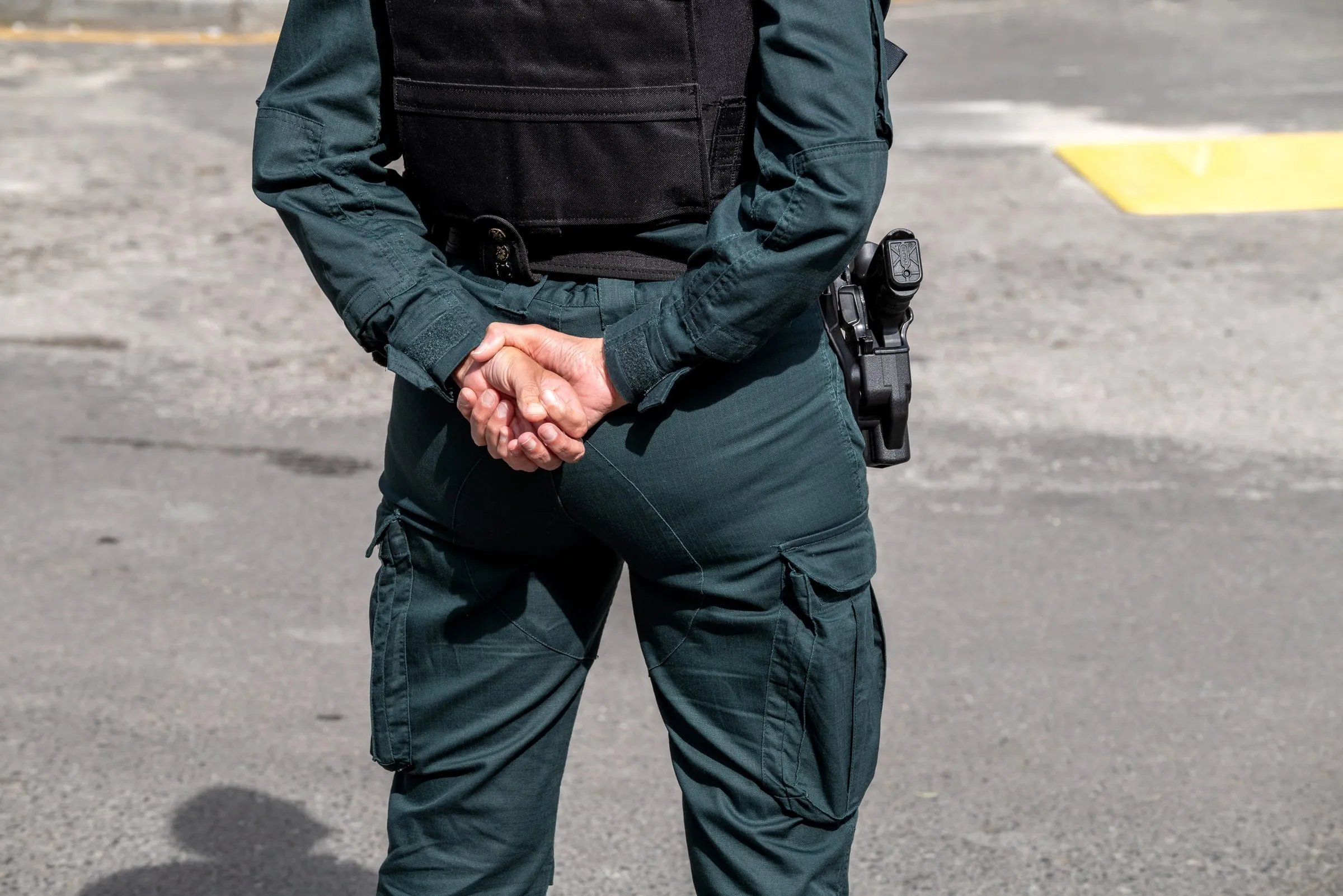
Yes, with a specific credential and specific posts
A Texas security officer may carry a firearm on duty only if they hold a Level III commission issued by the Department of Public Safety under Occupations Code chapter 1702, and only on a post the officer’s company and the client have designated as armed. The commission comes from completing a 45-hour course that adds the law of deadly force and a firearms proficiency test to the standard curriculum, passing that test with the type of weapon the officer will carry, and passing the required background check. Without the commission, an officer may not carry a firearm on duty, no matter what a client requests or what a post seems to call for.
Why the commission is tied to the company
A commission is not a general permit that follows an officer everywhere; it is issued in connection with the licensed company employing the officer. An officer who moves to a different security company is re-commissioned rather than carrying the old commission over automatically, and an officer whose employer’s own license lapses cannot legally carry under it. This is the same structure Texas uses for the unarmed registration: the individual credential and the company license are checked together, and both can be looked up on the Department of Public Safety’s public license search.
What “designated as armed” means in practice
A post being armed is a decision made in advance, written into the proposal and the post orders, not a choice an officer makes shift to shift. The client and the company agree which hours and which positions call for a commissioned officer carrying a firearm, based on the property’s own risk, and that decision is documented before the first armed shift. A commissioned officer can be, and often is, assigned to unarmed posts as well; the commission is a credential the officer holds, but the post orders for that specific assignment determine whether a firearm is carried that day.
What a commission does and does not authorize
| Question | Answer |
|---|---|
| Can a Level III officer carry any firearm they own? | No, only the type qualified with in the proficiency test |
| Can a Level III officer carry on any post? | Only posts the company and client have designated as armed |
| Does the commission grant police powers? | No, authority to detain, arrest or use force is the same as any private person’s |
| Does the commission change when force may be used? | No, use of force is governed by Penal Code chapter 9 regardless of commission |
| Can an unarmed officer be asked to carry? | No, only a currently commissioned officer may carry, ever |
How a client decides whether to request armed coverage
Most properties do not need armed coverage, and the decision to request it should follow from what actually happens on the property rather than a general sense that armed sounds safer. Cash-handling operations, certain healthcare settings, sites with a documented specific threat, and properties where an insurer or corporate security policy requires it are the situations that most often lead to an armed proposal. A supervisor’s walk-through is where that gets evaluated for a specific property, weighing the risk against what a firearm actually addresses, which is narrow: the defense of a life against an immediate threat, not a general deterrent against theft or disorder.
What happens when a firearm is present but not used
The overwhelming majority of shifts on an armed post look exactly like an unarmed one: rounds, access checks, reports, calls to the manager or to police when something needs attention. The firearm is equipment for a narrow circumstance under Penal Code chapter 9, and post orders on armed posts still put deterrence, observation and reporting first, with police called for enforcement in nearly every situation that arises. Officers deter, observe, report and call police for enforcement; carrying a commission does not change that sequence, it only adds one more tool for the rare case chapter 9 actually addresses. This is a summary, not legal advice.
Where to check the details
The Level III course article covers exactly what the 45-hour course and the proficiency test require. The use of force article covers the statute that governs when any force, armed or not, may be used. A client staffing or considering an armed post can also verify a specific officer’s commission number on the Department of Public Safety’s public search before the post starts and again at renewal.
A common assumption worth correcting
Some clients assume any uniformed security officer is armed by default, on the theory that a uniform implies a full range of equipment. The opposite is closer to true in Texas: the large majority of security officers statewide, and the large majority of the posts a company like Price Protection staffs, are unarmed, because most of what a post requires is presence, access control, observation and reporting rather than an armed response. Seeing a uniform tells a visitor nothing about whether the officer is commissioned; the post orders and the officer’s own credential decide that, not the uniform’s appearance.
What a proposal should say about armed coverage
A proposal that includes an armed post should name the specific hours or positions that are armed, distinguish them clearly from any unarmed hours on the same property, and reflect that the assigned officer holds a current Level III commission. Vague language, such as describing the whole contract as “armed” when only one gate during certain hours actually is, creates confusion for the client’s own staff about which officer is which. Price Protection writes armed and unarmed posts into the proposal by name and by hour, so there is no ambiguity between what was quoted and what is staffed on any given shift.
Equipment carried alongside the firearm
A commissioned officer’s equipment on an armed post is set by the post orders, typically a radio, a flashlight, the reporting log or tablet, and the firearm carried in a retention holster. Additional equipment, such as a baton or chemical spray, is a separate matter from the firearm commission and is issued only where the client’s post orders call for it and the officer holds the training that equipment requires. The weapons other than firearms article covers that equipment and the rules around it in more detail.
Questions
Related questions
Can a client simply ask an unarmed officer to carry a gun?
No. Carrying a firearm on duty requires the officer to hold a Level III commission; a client's request does not change what the officer is legally authorized to carry, and a licensed company will not put an uncommissioned officer on an armed post.
Do armed officers carry their personal firearm or one the company issues?
That varies by company policy, but the commission is specific to the type of weapon the officer qualified with in the proficiency test, whichever way it is sourced, and carrying a different, unqualified type is not permitted.
Is every Price Protection officer armed?
No. Most posts are staffed unarmed by Level II officers; armed, Level III coverage is assigned to specific posts where the client's risk profile calls for it, and a proposal names which posts are which.
Does carrying a firearm change when an officer may use it?
No. Use of force, including deadly force, is governed by Penal Code chapter 9 for a commissioned officer exactly as for any private person; the commission changes what may be carried, not when it may be used.
Related pages
Insights
- What the 45-Hour Level III Course Covers, Including Firearms Proficiency
- Use of Force Rules for Security Guards in Texas
- Security Guards and Weapons Other Than Firearms in Texas
- Can a Security Guard Detain Someone in Texas?
- Continuing Education for Texas Security Officers
- How to Verify a Security Company's Texas DPS License
Answers
Request a proposal
Request a proposal for your property.
Two short steps. Dispatch reviews every request and calls you back about coverage. For urgent unarmed coverage we can typically staff most sites within hours.
24-hour dispatch
(281) 326-9189